Paul Carter: Bridging Generational Gaps Through Technology
In this episode, Alastair Greener talks to Paul Carter , tech expert and BBC presenter, about how generational attitudes toward technology have evolved. They explore Paul’s personal…

Guest post
The Alastair Greener Generationally Speaking podcast has released an episode every two weeks since January 2025, with guests aged from 15 to 90. It is recorded at Granary Digital, the studio I run near Chichester, and I produce it. This is how an episode is recorded in batches, edited in Descript and published as audio, video and a web page with a full transcript.
Every other Tuesday since January 2025, a new episode of the Alastair Greener Generationally Speaking podcast has gone out, with guests aged from 15 to 90. At the end of the show, Alastair tells listeners that it "was recorded at Granary Studios and produced by James Jones". That is me, and Granary is the studio I run near Chichester. This is how an episode gets from our studio to your feed.
In the podcast studio at Granary Digital, in the Old Grainstore at Adsdean, near Chichester in West Sussex. The building is a 16th-century barn that has been a working studio since 2005, and the podcast suite was added in 2020.
The room is fully sound treated, with three 4K cameras, LED panel lighting and a 55-inch screen. The voices go through broadcast microphones on boom arms, and an engineer sets up, monitors the recording and hands over the files. Once the conversation starts, the guest should be able to forget all of it and simply talk.
Episodes are recorded in batches, several at a time. That keeps the fortnightly schedule running ahead of itself, so a release date does not hang on a single recording day.
Each conversation is captured on every camera and every microphone separately, so the decisions about pictures and sound are made in the edit, where there is time to get them right.
Each batch becomes one project in Descript, with a multi-track sequence for each episode. From there, every episode goes through the same steps.
Take off the start and end of the recording, so the episode opens on the conversation.
Run an automatic multicam edit, then check it by eye: both faces when both people are talking, an occasional cutaway otherwise, and hard cuts only, with no transitions.
Shorten any silence longer than 1.6 seconds to 0.3 seconds. The pace tightens, and the natural pauses stay.
Add the guest's name and role as a lower third the first time they are full screen in their first answer, which usually comes after an opening two-shot.
Put the ident at the start and the closing credits at the end.
Nothing in that list changes what anyone says. It makes the conversation easier to follow, and a guest of 90 and a guest of 15 both still sound like themselves.
On release day it goes out in three forms. The audio goes to the podcast feed, which carries it to Apple Podcasts, Spotify, Amazon Music, Deezer, Pocket Casts and Overcast. The video goes to YouTube. And each episode gets its own page on this site, with the video, the audio player, show notes and, for nearly every episode, the full transcript.
The website publishes each episode page by itself. A page dated in the future is held back until its date arrives, and the site rebuilds every night, so an episode appears on its release day without anyone pressing a button. Behind all of it sits one master sheet that tracks every episode, from the recording batch and the guest to the transcript, show notes, links and a sign-off column.
Transcripts make every conversation searchable and quotable, and they open the show to people who would rather read or who find listening hard. RNID estimates that 1 in 3 people in the UK are deaf, have hearing loss or tinnitus. A show about talking across the generations should be easy for every generation to take in, and a transcript is one of the simplest ways to help.
They also make the archive useful. Alastair's guests have included a 15 year old party founder, Kenan Noori, and a 90 year old inventor, Maurice Collins, and every word of those conversations can be found again from the list of guests or the episodes by topic.
At Granary Digital, a film, photo and podcast studio in a 16th-century barn near Chichester, West Sussex. The podcast studio there is fully sound treated, with three 4K cameras and broadcast microphones.
Every two weeks, on a Tuesday. The show has run since January 2025 and has released more than 40 episodes, with guests aged from 15 to 90.
On Apple Podcasts, Spotify, Amazon Music, Deezer, Pocket Casts, Overcast, YouTube or the RSS feed. Every episode also plays directly on its page on this site, most with a full transcript.
Send Alastair a note through the contact page saying who you are, which generation you belong to and what you would want to talk about. Guests range from teenagers to nonagenarians.
Listen to the latest conversations, with full transcripts.
Listen to the podcastIn this episode, Alastair Greener talks to Paul Carter , tech expert and BBC presenter, about how generational attitudes toward technology have evolved. They explore Paul’s personal…
Alastair sits down with Robbie Westacott, a millennial writer, marketing consultant, and founder of Seaforth Creative Group, who has spent his career helping events and media companies…
In this episode, Alastair chats with Anthony Stears , aka “The Telephone Assassin,” about how phone communication has evolved and its generational nuances. They explore practical…
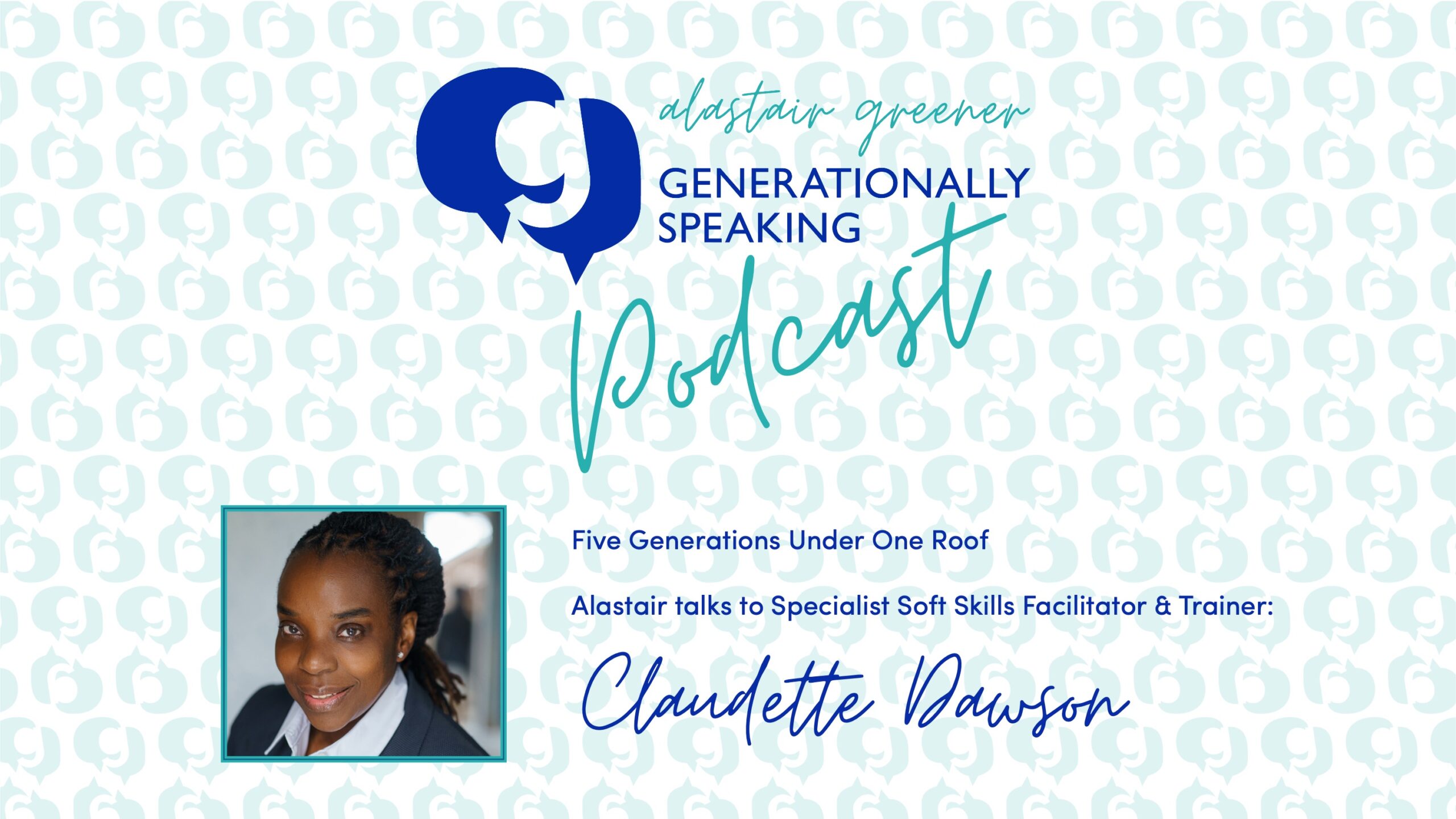
Episode: Claudette Dawson, Five Generations Under One Roof Alastair sits down with Claudette Dawson , a specialist soft skills facilitator and trainer , to discuss her unique…
Invite Alastair to speak at your event
Contact