
Podcast · Episode 18
Gillian White: Don’t Box Me In: Why Stereotypes Fail Across Generations
Guest: Gillian White, independent consultant, retail engineering. Host: Alastair Greener.
Audio
Video
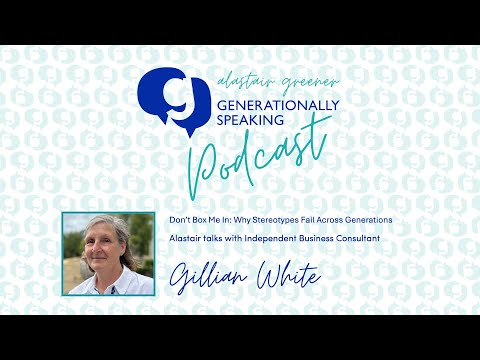
Alastair sits down with Gillian White , an independent consultant in retail engineering by training, and lifelong globetrotter. A self-described Gen X cusper , Gillian pushes back on generational absolutes: agreeing with Alastair’s mantra that we’re framed by our era, not defined by it. Growing up as “the new kid” across different countries taught her adaptability, curiosity and grit. These were traits she later relied on as one of only a handful of women on her engineering course and throughout a career spanning public and private sectors (including time working in Japan).
Gillian tackles ageism head-on, arguing that the word retirement often implies redundancy rather than reinvention. “Age is a privilege,” she says as she shares the story of an 85-year-old emeritus physicist still lecturing as the model of purposeful longevity. She reflects on overcoming bias as a young female engineer (prove competence, keep going, build allies) and why she now chooses clients who respect experience while using candid feedback and clear ground rules when she spots cross-generational friction.
As a parent to a cusp-generation daughter, Gillian aimed for aspiration over prescription by looking at slightly softer edges than her own strict, military-family upbringing, but with high expectations and wide horizons. She questions whether society has become too risk-averse , urging “careful risk-taking” so younger generations can build real resilience. Her advice to older professionals: stay relevant (keep learning, yes, including AI), be humble, and be generous with your knowledge. To Gen Z: talk to us, ask, listen, don’t posture, and don’t feel you have to mimic each other’s slang to connect.
Gillian White Takeaways:
- Ageism (including the baggage of the word retirement) erases value; purpose can and should evolve.
- As a minority in engineering, progress came from competence, consistency and allies (plus ignoring noise).
- If you meet subtle bias, try open feedback and shared ground rules. If it persists, walk away.
- Parents and leaders should promote aspiration + autonomy: listen more, prescribe less.
- For seasoned pros: keep learning, especially new tools and tech; be humble and share wisdom.
- For Gen Z: communicate plainly, ask questions, and seek to understand before persuading.
Gillian White Links enavant.co.uk Linkedin Instagram @vendingpixie
Read the full transcript
Automatically transcribed, so there may be the odd slip.
Alastair GreenerHello and welcome to the Alastair Greener Generationally Speaking podcast, where we look at bridging the generation gap by debunking myths, tackling stereotypes, and sharing practical tips on how we can build stronger intergenerational connections. Now, today I'm talking to someone who has lived and worked literally all over the world. Uh, she's currently an independent consultant specializing in. Unattended retailing, uh, graduating with an engineering degree. Her career spans private and public companies sprinkled with a side hustle of fitness coaching and a lot of volunteering. Uh, Jillian White, good morning.
Gillian WhiteGood morning, Alastair. Thanks for having me on the podcast.
Alastair GreenerIt's great to talk to you and, um, it's gonna be fun because I think you are not gonna let me get away with anything, which
Gillian WhiteAbsolutely not. Nor you, me, so.
Alastair Greenerwhether that's indicative of your generation or not, I don't know. And I'm gonna start off by just telling everyone that you are a Gen X cusper. So you are close to the cusp of being a boomer, which basically means Gen X. Uh, were born between nineteen sixty five, nine, and uh, 1980. And of course, boomers before that. So, first of all, would you say that you are fairly typical of your generation? When you look at the traits of a typical Gen X, do you fit in with that, do you think?
Gillian WhiteWell, I'm gonna say I fit in with me because, um, I get quite bothered by this whole. Absolutes of stereo of of generations. Clearly there are differences because lived experience is gonna be different. You, you, you know, chronological age is something you can't do think about. So there are probably things that I do where someone would say, oh, you are a typical Gen Xer and I'll use the, you know, um, but I like to think that I'm a bit more, um, spread out just, um, from my background and my education and also what I think and how I lead my life.
Alastair GreenerOne of the phrases that I use a lot is that we are framed by our generation and not defined by it. So what framed you growing up? What made you you do you think?
Gillian WhiteUm, I think a, a childhood of moving around so different, different, uh, geographies and obviously therefore locations, and I think that. Because of that, I was always having to be the new kid and learn new ways of doing things in new cultures and potentially new languages. And I think that, uh, made me think differently about how I operate. And I think the stereotypes that we talk about are about how we operate in day-to-day society and what, you know, so I, I'm informed by a broad childhood, but I can't help that I was born when I was, and therefore. I may make references to things that were different, you know, um, may, whether that's radio or tv, you know, British Forces Radio, I, I grew up with that. That's, you know, so that might not mean anything to someone who's never, never been in that situation. So I think it's situationally driven and I think it's individually driven. Sure there'll be things. I probably just don't want to admit it because I have a real problem with aging. As you know, you and I have discussed that, and labels associated with someone's this old, therefore, they do this. I, I really, it really grinds my gears, I'm afraid.
Alastair GreenerAnd it's an interesting topic, that whole thing of people being defined by, as you say, their age or stages of life and so on, because one word, which I know you hate is retirement. Um, because it's, it's a definitive word. But what's interesting about it, you, you look at your age, there are people your age, um, who are already, um, should we say, outta the workplace rather than retired. Um, so why, why do you have an issue with that sort terminology? Is it because you don't want to confront it, or is it because you just think it's too linear? Yeah.
Gillian WhiteI think it's too linear and I also really, I mean, honestly, age is a privilege. There are people that I went to school with that I know they're no longer with us. And, and because it's it and age doesn't define that you can't do things that other people of other ages do. And I think it just, I think it limits how we interact with each other. You know, if you dismiss someone rather than exploring what can they do and just say that they're this age, then they're retired and they're not interesting, you can become invisible. I think for me, one of the biggest issues, both with retirement and also the stereotyping is it's actually just ageism. And I, I just really struggle with that because you, you can be, people can be ages for young people. I mean, I'm not talking that it is not defined to retirement, but I really hate it. 'cause I think it says you are redundant, useless. I'm not, you know, you add no value and I, I actually think that's. Absolutely not the case. Um, and I should tell you a short story if I may. I, I had the privilege this week of going for, uh, a walk at Wisley with, um, an emeritus professor of. Physics, who has done amazing things in the world of lasers in which we haven't in our house. And he's 85 and still giving lectures and still as bright as a button and yeah, he can't walk as quickly as he did, but so he is retired, but you know, that's what I aspire to. I think. Never give up for me retirement says give up now. Maybe I'm overinterpreting, it could be me, but that's my real issue with it.
Alastair GreenerBut you're absolutely right in that labels and names do give a, a, a perception to people of what that means. And I think today we are seeing far more blurring of the lines, which is counterintuitive for a lot of people who want to have a very neat little box to put us all into. And the reality is that if you look at your parents at your age, they were very different to the way you are. And the chances are that when Gen Z gets to your age, they will interpret that age in a very different way.
Gillian WhiteYes, uh, absolutely. And, uh, I think it's, it is all about, uh, you're right, that word interpretation. How do you want to be, how do you want the world to perceive you? And more importantly, how do you want to perceive yourself? I want, you know, I'm thi I'm active, I'm healthy. I'm probably lucky genetically there's an element of that, but that's how I want to be seen. I want to be seen as adding value, having an opinion, having some historical reference that maybe you can share, and it it, you know, learn. To towards younger generations, but also learn from older. I, I think it's, it's about that being open. I find the, the stereotyping, it's like, what, you know, all of the other HR or psychological tools can be a bit limiting. And if you wear that label at your peril, I think. Um, and people use it as a defense mechanism. I'm this and I'm that, and obviously comedians use the generations as a bit of shtick and it's, you know, it gets a laugh, but the trouble when it goes from being a laugh to being used against you, that's, we should never do
Alastair GreenerYeah, because it becomes a judgmental tool if we're not careful because we, we see a stereotyping a certain way. And one of the things that I love about this podcast is not only do I get to talk to people from literally multitude of backgrounds and also age ranges, but also that I know my audience comes from multiple age ranges as well. And one of the things I love to do is to help. My guests show the audience who they are and the kind of world they grew up in, so that hopefully other people will un understand them a little bit better. And that was my sort of clunky way to get round to your upbringing because for your generation being an engineer and being a female engineer, that wasn't a particularly common thing. So could you tell me a little bit about that and what it was like growing up? In engineering, um, you know, at university and then the beginning of your career and how you coped with, let's be honest, probably a little bit of prejudice.
Gillian WhiteYeah, a absolutely. So, um, I wanted to do something in the sort of, you know, science, math world and, um, uh. At the time there was, there was a drive, and probably there still is to get women to consider engineering because there are many types of engineering. It's not, you know, um, and so I, I did that. There were two, I think there were about five of us in the year, the cohort I was in and across the mechanical materials engineering, I think I was probably about 120. So we were in the minority, um, and. I suppose there's part of me that's like, I'm gonna do, you know, why not? Why not? And I would say that to anyone considering a career that's maybe not classic, why not go and do it? Give it a try. 'cause the worst that can happen is you go and do something else. And, um, so it, it was great fun. Yes, there were, there was prejudice, but I think it, because there were a few of us. We were able to sort of support each other. And in some ways the best way to overcome the prejudice is just to ignore it. Because if someone's gonna think I'm a, a stupid idiot, whatever term, they're gonna think it anyway. So my job is just to get my, you know, get my head down, do the work, and um, you know, go through the rituals, you know, getting a long wait when you're an intern at somewhere and you know, all that nonsense and just riding with it. And I think what helped was because I had. Had been in experiences where I was the new kid in the class with moving around different countries. I was, I found it easier because by then you just, you know, you are sort of 18, 19, 20 and you've, you've kind of had those awkward moments and you think whatever, you know, and I, and reflecting back on it, that's just how I dealt with it. I ignored it. Like, 'cause they're gonna think that anyway, you're a woman, you can't do this. Yeah. Think that move on.
Alastair GreenerThat's exactly what I was going to bring up next actually, was how you overcame that inequality. You know, the, we hear often that women, especially in engineering and in industries where the, the women aren't as prevalent. You almost have to be better than men to get that same level. Was that something you experienced?
Gillian WhiteYes it is. And you just have to constantly prove it. You have to prove it more often, but then when you do prove it, that's sort of the penny drops. And, and gradually people see that, you know, it's however you present is irrelevant to the outcome. But you have just got to be kind of, you just gotta be very gritty, I suppose. Uh, resilient is another word for it. And just, yeah, it will bother you, but you have then got to sort of scrunch it up, throw it over your shoulder, and figure that you can't change what other people think of me as none of my business. And you have to adopt that even though it's hard and at times you won't get it right. You will feel it's dreadful, but, you know, and, and then take that into the workplace and, and do the same, you know, because you've just got to face into it. There are people who will just think you are not very good. And, and if you know you are, you've just gotta carry on and prove it, you know, again and
Alastair GreenerA previous, a previous guest that I chatted to and I reference a lot is Dr. Linda Shaw, who's a neuroscientist, and she talks a lot about unconscious bias. And that's the whole point. It's unconscious. And you know, one of the things that in a sense you have an advantage at your age is that you've. You've experienced generational bias at both ends. So you, you obviously experienced it, not only being female, being a young engineer, you will have had, I'm sure the patronizing, you know, methodologies towards you and, uh, way people dealt with you. And now you might have from younger people, some generation by, so let's, let's first of all talk about. When you were younger, that generational buzz, and then we'll talk about maybe any that you're experiencing now. So what was it like? You know it going through that as a young female engineer?
Gillian WhitePeople just not believing you could do it and you knowing you could because you've got the same tools and equipment, and then just having to keep constantly battling through and proving, proving the point and not being, you know, I suppose being a bit of an awkward cuss and not being willing to give. You know, willing to give up on that and realizing that, uh, it's, uh, it was almost because I wanted to prove that I could do it. And, and the pe the more people were against me, the more that made me want to show that I could do it. And then I got involved with, you know, women in engineering, um, activities and outreach, um, which were going on obviously to try and get more. Women into the industry. Um, and so I, so I, I took it and used it as a tool to say, look, forget all that and try and encourage those coming up to, you know, if that's what you want to do and you're good at it, then give, then give it a go. Why not, you know? Um, and yeah, and, and then in the workplace, same thing. And, and I did some work with in Japan. So you've got female, you've got, you know, western and an engine. So the whole thing, and again, having the belief in yourself. Not cockiness, but the belief that you can do this and having some, a support network around you that's like, yeah, you can do that. And that very much from my, from my father. It was like, you know, who was even more old school, but you know, because I was his daughter, and same with my sister, because she's my daughter. She's gonna be able to do that, even if you don't think that's what girls should do. So, really bizarre and again, counterintuitive, you know.
Alastair GreenerHow about the organizations? Were they supportive of you?
Gillian WhiteI was hugely lucky. Um, yes, I was hugely lucky in my first role when I moved to the US with a, a US company. And I had a very forward thinking manager who, um, was really, you know, very supportive of my career. Made sure that I was getting all the professional development and encouraging me. Um, and I think because he had two young daughters himself, he was sort of seeing. If I can do this for someone in my team, then this is the, this is the world I want the next generation to come into. I was just lucky, I think, and then I moved to, when I moved back to the uk, equally lucky that I moved to organizations that understood the power of all the different skills that people bring. You know, whether, whether you wanna call it diversity or whatever, whatever term you want to use. The power of many and different skills and opportunities to get the best results and irrelevant of, of, you know, background.
Alastair GreenerAnd you're probably gonna hate this, but it's also fairly indicative of your generation, that level of resilience that Gen Xs are unknown for. And as you've already said, that resilience came maybe because of the era in which you were brought up, but also your personal circumstances possibly enhanced that level of resilience.
Gillian WhiteTo be honest, I wouldn't want to be a teenager right now. I think the world, you know, with, we didn't have social media and stuff like that and it, you know, it is not all, absolutely not rose tinted glasses. Many things were great, but many things, it was just complicated to get things done. I mean, letters. Had to wait for things in the post, but I think that you are right. The, the background and the timing. I, I think we, we have that and the opportunity and we didn't have as much of the sort of social competitiveness and fears that that. People have now. And you know, it's very much, that's why I say lived experience is one thing and you can benefit from that. And then you have to learn how to adapt as things change. Um, so yeah, I think, I think you're right. And I think part of that's just me, you know, little bit, not bloody minded, but you know, I want to be able to do things. I want to have the opportunities other people have. I want to get on and do things and, and. Being able to have that internally. I think that's just in me. Um, and it hasn't always been easy. I mean, I'm making it sound like it has, but obviously it hasn't, you know, there are, there've been many heads in hands, you know, but, um, I, I think I do benefit from that.
Alastair GreenerWe will come to this in a second because you've got a Xal daughter, so she's on the cusp between millennial and Gen Z. So I, I definitely wanna come back to that in a moment in terms of, um, comparisons. But let's just finish off that whole thought of generational bias. Now, as an independent business consultant, are you experiencing that at all when the. We see an industry, the major decision makers are now, you know millennials and therefore quite a bit younger than you are using any form of generation bias in the other direction.
Gillian WhiteUh, I don't see it, but then I wouldn't work with someone who treated me like that. You know, I would, I, I'm, I'm in a, that position where I'm in, you know, I've got knowledge in an industry so I can choose and I will choose to work with people that respect across the piece they respect you for. Knowledge and approach and input, rather than judging a book by its cover. I just wouldn't work with them. But I'm very lucky and I, I do understand my privilege because not everyone can do that. Um, and yeah, I'm sure if I were in a different place and I was working in a business and that was, you know, the, there were, there was, there was challenge or I didn't feel comfortable, I'd probably just leave to be honest and go and do something else.
Alastair Greenerdo you, how would you navigate it if it, if it was kinda like borderline? So in other words, it was a client you really were keen to work with. The project looked really exciting and you thought, great, but there was a little bit of that bias going on and you made a judgment call to say, actually, you know what, I'm gonna give this a go because this is worth it. How would you go about then navigating that potential slight. Generational buzz that you might experience, how would you steer around that?
Gillian WhiteI think you've got to get into the open, honest feedback, how this makes me feel and, and, and get into that conversation and, you know, sort of arbitrate or mediate to find a way of working because you can't change what someone thinks or their, their influence is more mine. So what you've got to do is actually be honest about how you can make something work for the good of the project. The good of the business, the good of the opportunity. Um, and if you can't, I think then it's, it's be whole. I, my choice would be to walk away because there's only so many times, you know, it's the Einstein, you know, keep doing the same thing. If, if it's, if someone is so entrenched that you cannot change them, then uh, I think time to move and find something different. But give them that feedback. 'cause I think we only learn by being exposed to, you know, the good and the bad of the things that, that we bring. Um. That, that's how I would do it.
Alastair GreenerAnd that's the
Gillian WhiteThat would be uncomfortable on both sides, I'm sure, but, but I'm not frightened of doing that, you know?
Alastair GreenerBut, but as I said, you know, it's one of those things that the younger generation, generally, they're more in that framework of communication, of feedback and discussion. Where maybe when you are entering the engineering world that, you know, if you tried to do that, then you would've been shut down and closed off and get on with it.
Gillian WhiteYes. Yeah, I think, I think you're right. Um, and I think it, it was you had to learn a different set of navigation skills 'cause in, in that circumstance, because if people were more closed, right? I think the, the world of work has improved in that sense that there are now reviews and feedback and opportunities. It's not perfect obviously, but I think there's more willingness to have difficult conversations. Um, and I think that's absolutely key to it. You know, whether it's about how someone speaks or addresses you or, or, you know, and be willing to learn. I think you, you, I've got to be willing to learn. Other people have it. It is both ways. You can't just stop and become so stuck in, I've always done it this way, it's always been this way that just, you know, everything evolves, language, ways of working, how you solve problems. You know that that's for me, really important.
Alastair GreenerAnd that's one of the challenges for some fellow Gen Xers that maybe they are a little bit more entrenched in their ways and don't have that level of flexibility. How would you suggest to somebody who may be a. Does struggle a little bit with the new ways of working. What kind of things would you suggest to them? And maybe you encounter them in, in your work and, and you want to help them 'cause you like them, but you know that they're not maybe, uh, as with the program, shall we say, as they should be?
Gillian WhiteI think that's where coaching and mentoring comes in. I think that's hugely important. You know, if you've got, if you've got someone that's talented but sort of stuck behaviorally, just, just trying to coach 'em through that and, and do it in a way that doesn't sort of take from their skills, but allows them to perhaps see it from someone else's viewpoint. I mean, I must admit we lived near a sixth form college and there are days I was absolutely mayhem. And then I think now, what was I like when I was 18? And you have to kind of ask yourself, and I think if someone is stuck and may maybe try and help them to see it from the other side, you know, try and understand why that's causing friction or tension or a difficulty. And then try and sort of almost workshop it like and, and help provide strategies. So my strategy is to take a breath. Was I that like that at whatever age? And okay, I can translate because it's easy to get riled up about things. Um, and I think that's how I would do it. So, you know, getting with someone saying, look, I saw you do this. Would you, you know, would you like to discuss how maybe that could have gone better without slapping them in the face? But actually, honestly, um, and if they're not willing, then I think, you know, you have to read, you have to read that signal. But yeah, and I think it's a shame. I think that's what probably does drive this perception of the different generations and the sort of the intransigence, because people do almost can almost. Give up and say, well, that's, I'm not, I'm not changing. It's down to someone else. And I think that that's a dangerous place to be. Yeah.
Alastair GreenerAnd it'll be interesting to see how the next generation, how they deal with it when they get to, you know, these sort of older age and, you know, a different stage of their lives. But I, I wanna come back to, um, your, your daughter. Um, she's, she's a, a xal. And make the comparison a little bit maybe of how you were brought up and what aspirations you had for her in the way that you were going to bring her up, whether you were going to replicate the parenting that you received or whether you made a conscious decision. No, I'm gonna do something a little bit differently. What was that sort of process for you?
Gillian WhiteUm, I think I was going to be a little less strict because I, you know, you put military and, you know, whatever Do. Generation, my parents were together. That, and you know, the schools I went to, that was, I wanted to be slightly less strict, but I also wanted, the key thing for me is aspiration. I don't care what the aspiration is, but I think it's really important that you create an environment to, you know, go as far as you can, you know, and. S find what you're good at and really, really pursue it and never give up on, on something. And if, if someone has an ambition, it's like an itch, you know, scratch it and then really see if you can, can go there. So, a little bit kinder, probably a little bit more frantic because obviously, you know. Working, parents, traveling, all that kind of stuff, and relying on other people. Um, but always trying to keep an open mind as well about the big wide world and do travel and, you know, experience things. So I think those are the two things. Slightly kinder and definitely keep with the aspiration. And why not just that's, you
Alastair GreenerAnd it, it, it's always very easy to look in the rear view mirror and think, okay, this happened, that happened, what would I have done differently? And so on. And because when you are there in the moment, you just do your best and you just do what you can. Looking back at the way millennials and Zals were brought up, is there anything that you might have changed or do you think society could have done a little bit differently for that age group?
Gillian WhiteI think we've, you know, the whole, I think, I don't know if the word, I mean, I think. The whole paranoia about safety and other people. I mean, you've got to create enough common sense and rules and strategies that you are, you, you, you take care. But, uh, you know, I think in, in some ways, sometimes it just goes too far in that sort of whole learning to take risks. Learn from them. I think that potentially, and it is always a conundrum for me because I look and people moan about the anxious generation, all that kind of stuff, and moan is, I use the term generally, but we were the people that brought 'em up. So we have no right to, you know, we were their influence, we were their older influences. And I think that for me is just, have we lost the careful risk taking, if you know what I mean? Like. Uh, and perhaps that's the one thing I, I think maybe is missing, you know?
Alastair GreenerAnd of course it, it, it's all very well saying it, but when you're caught up in the moment and ev that's what everybody else is doing. It, it's just learning from that. And naturally, I read a report the other day about Gen Alpha and of course their parents are millennials and older, um, old, older. Uh, gen Zs and how they're being a little bit different in the way that they're bringing up their children based on how they're brought up, and that's what happens, isn't it? Because I'm sure that your parents had a view on the way that you were bringing up your daughter.
Gillian WhiteAbsolutely. And it, I think it flip flops, there's a little bit of, you know, uh, you take the bits that perhaps are good and then you think, well, I I didn't like that. You know, like I say, you know, if you've got very strict parents, you're probably gonna be a little bit more relaxed because come on. You know? Um, and so I, I do think it, you know it, and then it goes round because you, you know, and circumstances change and obviously everything around us has, has changed in that time as well. So, yeah.
Alastair GreenerYou've got a huge amount of experience in business. You've traveled, you've, you've, um, done some amazing things within your career and looking at other people, first of all, for people who are maybe at your, um, your stage of your life, shall I say, without using any other words that might be cliched, what advice would you give to others in terms of navigating the workplace being a very different place than it once was? And going forward and you know, as you said before, you know, you don't have any intention to, um, slow down massively anytime soon. So what kind of advice do you have to people of your similar age of how to navigate that best?
Gillian WhiteAnd great question. I think there's two things. If you want to stay within, you know, working in, in employment of some sort, then just staying relevant, making sure it's right for you. But also, and I. Being a little bit humble, not in the McCorby sense of the word, but being, realizing that maybe it's, it's okay. You know, you are, you're probably gonna be managed potentially by someone of a different generation, and that's fine, but be, be generous with the knowledge you have that can help someone. Who's coming up through their career. Um, and if it's right for you not to be working and to do other things, voluntary things that's still working, then just make it right for you. Be comfortable with where you are at. I'm uncomfortable with being perceived as being, you know, at, in the long grass and of no value. Um, so I would say be honest about. What you are and if you are well and, and what interests you. Um, and if you are lucky enough to be able not to work and you can go and do whatever you do, holidays or whatever, then that's great, but be honest about it and, and don't feel guilty. Whatever decision you make, your decision is entirely personal. And mine is to carry on working and being relevant. And if you're gonna stay in the workplace, be relevant, you know, get on some courses and learn about AI or other skills or whatever. I'm not saying people don't, but I think it's really important that you continue to learn, uh, be relevant and, and add the value. Um, otherwise you will potentially be that person that gets pushed out into the long grass.
Alastair GreenerAnd actually you mentioned AI there and I can't believe we, I got through a whole podcast with an engineer and we didn't talk about ai. We're gonna have to talk about that another time, I think. But I'd just like to wrap up in terms of younger people and younger people interacting with more mature people, shall I say. Um, what kind of advice would you give them in terms of, so if you were working with a Gen Z today? What advice would you give them to get on better with you, to connect better with you as a Gen X?
Gillian WhiteUh, talk. I think actually, I mean it, you are all about speaking and communication and I think it really is about that and be willing to sit like a, it's important both ways to see the world through a different set of eyes and try and put yourself in their. Shoes. You can't, and don't try and be them. You know, if, and we talked about this in a different call, you know, if, if a word or a phrase has changed, 'cause languages evolve and it's used in everyday, you know, conversation, that's fine. But don't try and speak like a Gen Z or a gen alpha 'cause you're gonna look, you don't look stupid and you want respect both ways. So, um, you know, try and, and if, I think it's also about, if you don't understand something both ways. Just ask, you know, that fear of, and I think we've probably all done it, you know, the fear of like, I should know this, but I don't, and I don't want to look stupid. But I think it's about asking those questions, you know, seeking to understand. And I think for the coming up, you know, people in younger generations. Ask those questions, why do you do it that way? Why? And or, and then be willing to show someone how to do it. You know, like the feed of, you know, catch a fish analogy. Um, and I think that's really important. I suppose it's about learning, about being open and about you aren't always right and you don't always need to be right, but you can share that information and improve, um, that you know, and be willing to have those conversations and don't fall for the stereotypes. I mean, to come back to where we started, you know, don't, don't, yeah, it's funny and it's, you know, on a reel in, on Instagram, but it is it real, you know, is the real, real,
Alastair GreenerI think that that's a perfect closing point. I, I love your, your, your concept almost of yearn to learn and then to communicate. Um, great advice, Jillian. It's been fantastic talking to. I've learned a huge amount and it's always great to get different perspectives from different people. So thank you so much indeed for being with us. We've got some, uh, details about you in the show notes, so, uh, thank you very much indeed for being with me.
Gillian WhiteYeah. Thanks for having me. Good chat. Thank you.
Alastair GreenerThank you. And thank you for listening and watching, and I'll be back again in a couple of weeks. Bye for now. The Alastair Greener Generationally Speaking podcast was presented by me, Alastair Greener. It was recorded at Granary Studios and produced by James Jones. Please follow us and leave us a review wherever you get your podcasts. To find out more, visit generationally speaking.co.uk.