
Podcast · Episode 37
School Superhead on Why Today’s Students Question More
Guest: Nick Bowen, former headteacher. Host: Alastair Greener.
Audio
Video
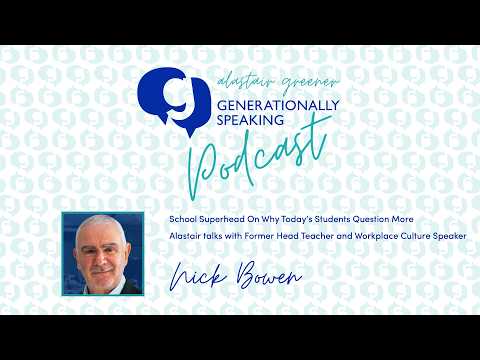
Former school “superhead” Nick Bowen reflects on 20 years leading large secondary schools and turning around failing institutions.
Nick explores how education has evolved, from low accountability to data-driven performance management and why today’s students demand earned respect rather than automatic authority.
They discuss generational shifts in parenting, rising parental accountability pressures, and what business leaders can learn from schools about belonging, empowerment and accountability.
5 Highlights
- The dramatic rise of accountability in education
- How modern students require relational authority, not positional authority
- The growing challenge of parental entitlement
- Building belonging in newly merged school communities
- The balance between empowerment and accountability
Nick Bowen Takeaways:
- Belonging is the foundation of performance
- Accountability and empowerment must go hand in hand
- Generational differences in schools mirror those in workplaces
- Leaders must actively understand new generations entering their institutions
- Legacy leadership means passing on wisdom, not clinging to authority
Nick Bowen Links
Read the full transcript
Automatically transcribed, so there may be the odd slip.
Alastair GreenerHello and welcome to the Alastair Greener Generationally Speaking podcast, where we look at bridging the generation gap by debunking myths, tackling stereotypes, and sharing practical tips on how we can build stronger intergenerational connections. My guest today was a head teacher in a large secondary school for 20 years raising aspirations and achievement in areas of deprivation. He's now a professional speaker on driving transformational success through creating a culture of belonging, empowerment, and accountability. Today we are gonna talk about generational differences and similarities in schools and education. So it's a big hello to Nick Bowen. Hi Nick.
Nick BowenHi, Alastair. Nice to be here. Thank you.
Alastair GreenerWell, thank you for joining me and um, again, I think you are my first superhead that I've interviewed in my podcast series. Um, and, and a superhead basically means that you ended up in your career, you, you've now left that, but you had basically in charge of a load of different secondary schools.
Nick BowenYeah, I, um, I, I, I, I took over a, a school in Ley and set up a school in Ley from two failing schools, which was, you know, 2,300 students. So that's a. A really huge school. You know, we had 400 not in, in each year group. And, uh, people called it the flagship school, the super school, and the first article that appeared in the, in the, in the local paper, uh, referred to me as being a super head. Um, and I kind of finished the career, still overseeing that project, but I also, um, took on the role of, uh, supporting. Uh, other schools within, uh, the, the local authority, uh, headed up what we call the, the, the, the, the Barnsley Schools Alliance. Uh, working with all those schools, particularly the secondary schools, uh, in that, and also forming a, uh, uh, adjoining and partnering with the trust, uh, and, uh, academy Trust, um, uh, Highland Highland. Common Academy Trust. So yeah, from, uh, from starting as a head teacher, by the time I finished 20 years later, I was working in all sorts of different schools. Uh, and yeah, the term superhead kind of, kind of sticks and, uh, but you've got, but you've gotta live up to the expectations of that, I guess.
Alastair GreenerAbsolutely. Yeah. Well, let, let's go back to the beginning because actually we've established that you and I are exactly the same age. Um, so we are of the same generation, so we're sort of cusper boomer, gen X. Do you relate to that label? Do you consider yourself to be a, a stereotypical late? Um, early late Boomer? No, hang on. Early Boomer Latex.
Nick BowenYeah. I, I, I, I think, I'd certainly think so. Yeah. Um. I, uh, I very much feel a cusp as well. So, uh, from a, from from the Boomer, I'm, um, I, I am competitive. I often find myself saying I'm reluctantly competitive. It's like, I don't want to be, once I start something, I just can't, I can't help it. Um, I'm also really kind of self-reliant as well. You know, I, I, I told, I, I. I brag about the fact that I've always done my own ironing, always do my own washing, always do my own cooking, you know, very, very kind of self-reliance. And, and that's kind of a trait of, of, uh, of Gen X as, as, as well. Um, I was the, the youngest, uh, sibling. I was the only, um, the only person in our family who's four of us, four children, uh, who, who went on to university. Um, and I became a, you know, a, a a a high earner, um, kind of then looked after my. Um, mum with Alzheimer's, you know, along with my brother. So some of those traits are, are kind of pretty, pretty standard across that, you know, and also that notion of, um, being really career focused, but also that real kind of Gen X thing of, um, work life balance. You know, really managing to kind of, uh, having a devoted career, but also a really good social life. I kind of, uh, play hard and, and, and work hard at the same time. Yeah. Yeah. So I do identify with that.
Alastair Greenerlet's talk a little bit about your work because you know of your generation, you will have seen tremendous differences between schools when you grow up, when you grew up versus today. And I think for lots of older generations who haven't been into schools, they have no idea what it's like. In a school these days. Um, I mean, yes, you said you, yours were failing schools, but when, when you took them on. But they will have evolved and, you know, become the, the schools that they are today, um, over a long period of time. So give, give us a bit of an idea of an overview, if you like, of how education has changed in the last say, 30, 40 years.
Nick BowenI think, I think the most, the most glaring thing for me, um, is. Is accountability. So I'll, I'll start with that. You know, when I first started teaching, um, there was pretty much zero accountability from, from a, from a staff point of view. So, for example, um, as a young teacher, when the examinations results came out. We kind of, nobody was kind of looking at those. There was no comparisons between school. There was no league tables. Um, no one was kind of, there was no real performance management. Um, it sounds like I'm painting a really bad picture. There were really happy places, but in terms of accountability, you know, there really was very, very little accountability. Um, and, you know, stories that you, you have, you know, I remember, you know, teachers, pe teachers sitting on with their feet up on the desk, reading the newspaper, sending the kids to do a few laps around the, around the, uh. Around the, uh, the, you know, the, the, the field. Now those are fairly stereotypical views, but that, that for me has been one of the real things that the profession, if you like, has become much more professional. Um, there's huge, huge amount of accountability now. There's a huge amount at stake. Um. You know, head teachers have to make sure that the school is meeting the needs of that community, um, and that results are being achieved. Teachers have to perform. Uh, there's a very robust performance management, um, system now for, for, for teachers. Um, and, and, and, you know, students very, very, very much pushed with, with, with targets. Lots of much more use of benchmarking. Uh, and, and I see all those things as being a really good thing about the, the, the profession. Because, you know, if you worked in sales and you kind of, you know, you sold a bit one day, you didn't, one day, one day you didn't really bother working. Very hard to say, you know, and, and at the end of the day, you weren't selling very much. You know, you'd, you'd be a very poor sale and you'd probably end up getting the sack, whereas it was possible. Back 30, 40 years ago, um, you were kind of empowered if you like to, you know, you get on with it, you're the professional, you know what you're doing. And actually, you know, there needs to be that level of accountability and I think that's one of the things that's, that's really important for me. The other thing
Alastair GreenerAnd what about the, oh, sorry. Yeah, carry on.
Nick BowenI said, the other thing I think is that that's happened is schools have become much more inclusive places and having to focus much more on. The whole child in terms of their wellbeing. Uh, now, now, you know, schools have always had a duty of care. But I think, you know, there's, you know, I think that when I retired, you know, and, and, and left a huge setup of wellbeing and inclusion services within the school, you know, to make sure that students were being supported, that they weren't being excluded, that their ma needs were being met, that their families needs were often being met as well. Um, that I saw has been a, a, a really, a really big change. And I guess the third thing for me would be, um. A strong focus now on, you know, preparing young people for the world of work and a real emphasis on skills and, you know, uh, on, on the numerous routes that there are. Into, you know, gainful employment, uh, and, and, and, and, and future learning. Um, you know, I always felt in the past people kind of fell off the end of the cliff. People left school often at the age of 15 or 16 and, and, and kind of that was it. And, and there's, there's much more, um, there's much more focus, focus on, um, you know, making sure that people are in, getting the right training and getting into, into, into, into great employment. Universities only a.
Alastair GreenerYeah, absolutely. And, and actually some people, it's quite interesting you speaking quite positively about the level of accountability of schools because you sometimes read in the press that, you know, reports that some schools and heads and teachers, you know, feel constricted by the level of accountability and the, and the level of, of, of, um. What they have to do with reporting and so on. But I, I, I could see us going down a bit of a political route there. So I'll, I'll steer well clear of that one. But, um, I'd be really interested to see just the way that you communicate with students today, compare it to when you first came into education, the way that you communicate with students. How's that changed?
Nick BowenI think maybe it's 'cause I was a cusper, um, but I. When I first started teaching, I, I, I was able to really relate to and form some really positive relationships with, with the young people, with the students. Um, and as, as I progressed through my, through my career, I kind of to the, to to the further end when you get to say gen, gen Z, um, then the, the. The issue has been much more around, um, well, the, it has been, it has become harder, um, it has become harder in terms of communicating with the, with young people, I think as, as time has gone on. Uh, so, you know, I roughly spent the first part of my career teaching Gen X, spent the rest of the time teaching millennials and finished my career in the, the big school mainly with, with, uh, you know, with, with, with, with Gen Zs, and. Um, it
Alastair GreenerIs it harder though because of the, the, the gap between the, your generation and theirs, or is it something more fundamental than that?
Nick Bowenit, it, it's interesting 'cause it, it would be easy to kinda say, you know, as you kind of get older, you lose touch with the younger generations. But I, I think it's, I think it's more than, more than that really. I, I think it's. It's, um, it, it, it, it's, it's attitudinal really. I think, uh, and, and I don't mean that in a negative way, I mean in a positive way. Um, you know, when I first started teaching, it was very much, you know, that kind of the, the, the, the, the Generation X was very much, uh, around, you know, well, you know, you are the teachers, you, you know. Yes sir. No sir. Three bags full, sir. You know, do this because I tell you to do as you're told people towed the line. Um. And now people are, you know, young, young people are, are much more, um, much more questioning. They're much more aware of what they think their rights are. Uh, they're more, they're more willing to challenge and, you know, why do I have to do this, Sarah? You know, why are we doing this? And I, you know, um, and, and. Teaching. I want to very clear. Teaching is not about you. You know, you're not there to be their friends. They've got enough friends. They don't want teachers as friends, but I found this as time went on in my career, you had to, and I think it's a good thing. Teachers had to earn the respect of the students in a way that they perhaps didn't have to in, in, in, in, in, in the early days. Um, now. Teachers in the early days did go out and, and, and, and kind of, you know, those people who took the time, they got the respect. Those teachers who didn't, they might not have got the respect, but people would've still told the line, because that's what you did. You are the teacher and I have to do is I'm told. And, um, but where, whereas now, you know, teachers who, who struggle to communicate with young people, um, and who struggle to develop a relationship. They also, they're the, they're the staff if you like them, who struggle to, you know, to to, to teach effectively, to get the best outta the students. And that's where you then get issues around, you know, kind of student behavior, students attitude to the subject, um, and students and teachers who. You, uh, uh, who kind of go outta their way to develop that relationship. And, and it's not easy, you know, I, I, I remember, you know, as a head teacher standing in the, in the middle of a, uh, the, the, the, you know, the, the, the main hall with, you know, hundreds of kids around, you know, saying to this kid, come here, you know, and he just looked at me and went, no, and, and, and kind of walked off, you know? And, uh, now obviously he was dealt with later. And me and him became, became, had developed a really good relationship. 'cause I took the time to do that. And in the end, he would do anything for me. But at the time, you know, in the old days, I don't think that would've happened, that someone would've just walked away. And again, I'm not painting a bad picture. I'm saying I think it's a positive picture in some respect.
Alastair GreenerBut do you think that is also to do with parenting, that that's changed a lot? We hear a lot about the young people suggest that the young are being more entitled. And then I hear from other people who are in the teaching profession that actually it's the parenting that's become more entitled. Where? Where do you stand
Nick Bowenit is, it is. And you know, I, I, I think, you know, it's hard because everyone's a parent. So as soon as I open my mouth and start speaking, I'm gonna insult the whole of the population. But it's kind of a, you know, what we kind of see is what I see really is that, you know, when people say to me or to anybody who, especially who works in senior leadership, or even as a teacher, you know, what's. What's the worst part of the job or whatever? I, I guarantee most people will say parents, you know, parents, uh, they, you know, they have the best interests that they, you know, they, they, they love their children. They care about their children. I get that. Um, but, you know, the, the parents have become enormously more, um, demanding now in terms of holding schools to account to make sure that they're doing the best for children. That's a good thing, but. also then got, you know, if I say if I had 2,300 students, I had several thousand parents, all who may have had a different view of how things that should be done. And I suppose, you know, when I first started teaching on the whole, parents would kind of say, well, you know, the school knows what they're doing. You know, we, we'll kind of leave them to it. Uh, whereas now, you know, parents, you know, are much more want to be. Holding the school to account and, uh, in, in, in many ways, you know, over defending their, their, their students. You know, I mean, I could give you a simple example of, you know, telling a kid to tuck his shirt in. You know, suddenly the kid's saying, well, why, why do I have to tuck my shirt in, you know? And. You kind of say, well, you know, 'cause I took my shirt in. It's just a rule in school, we all want to look smart. And then the child kind of, you know, starts tuting and you know, so you, and then, then they start swearing, you know, and then you, then you send them home and then the parents come in and instead of saying, look, I'm never so sorry if. You know, a parent will come in and it's like, you know, well I can't believe he was sent home for, not took his shirt in. And then you're having to get into an argument with a parent and say, well, actually no, that's not the case. You know what, you know, it actually kind of flared up. And then there was some swearing and then he was very rude and, you know, it would've been better if he'd just took his shirt in and then a parent will say, well, I brought my child up to question, I brought my child up, you know, not to just accept rules. And um, now obviously I'm just painting a particular scenario. I'm trying to say that, you know, over time there has been more of that than, um, you know, than there was in the past. However,
Alastair GreenerAnd we hear that a lot, don't we, about the questioning of the younger people. Um, you know, and, and it's interesting. They're questioning at school and then of course they get to university and they get into the work. Place and they're questioning the workplace. And as I always say in my research that I did for my book is that, you know what happens in a, a young person's early years and that carries on throughout their life. And when bosses are saying, well, why are they questioning? It's a very clear reason for it because they've been doing it all their lives up to that point. So how do you steer those children in a way with the, where they're going to be, have a better understanding of the expectations of them? Because it, it's tough, isn't it? You want to let them express themselves on one hand, but also we're in a conformative society. So where's that balance and how do you communicate
Nick BowenIt, it is and it is a balance. 'cause on the, on, on, on the one hand, you know. Uh, you know, I just painted a partic a particular picture there where it's quite frustrating, but, you know, do we want to, do, we want generations of young people coming through where they're just saying, yes sir, no sir. Three bad falls, sir. You know, I'll just do as I'm told. You know, it's a, it, it, it, it's a good thing, but I think it's what the, the sorts of conversations we'll be having will be around, you know, it's all well and good, you know, to question, but there comes a time when you have to. You know, understand that, you know, you are one person with a particular view, but for the good of the whole community, it's important that we do this now. You know, I think, um, I. I, I think it, it, it's important that, you know, that, that that schools, in doing this don't just, you know, kind of want to go back to the, to the, to the, the good old days or whatever the bad, the bad old days or whatever you, you want to call it. I think it's, you know, making sure that, you know, in the classrooms, around the school, in the relationships that you have, that you know, those conversations are important. You know, you know the person who's always late, you know, you talking to say you do realize that if. If this happens, you know, in the world of work, you'll, you'll lose your job. And well, well, I don't care. Well then you won't have any money. Do you like going out? Do you like partying? Do you like, well, you wouldn't be able to do that. You know? Um, and, and having those kind of conversations I think is a, is a good way of kind of getting to know the young people and, um, and, and, and kind of. Um, I suppose harnessing that, that, that wonderful ability to want to question, uh, and, and, and turning it into something that's not destructive, that's something that's productive, that you don't kind of allow it to just keep going down, you know, um, down cul-de-sacs, you know, and it's not going anywhere and it's just unhelpful.
Alastair GreenerIt's a huge responsibility being a teacher, isn't it? Because you, you are responsible for the next generation who are coming into our communities, into our workplaces, and the way that you shape them is, is, you know, is going to be massively. Um, instrumental in, in their futures. And for you as a superhead turning around a school that was failing to one, that is now serving the community in a far better way. You know, how do you deal with that level of responsibility and, and not drive yourself mad because you, you know, it's such a big job.
Nick BowenUh, it, it, it's, it's interesting you say that. I mean, I, I often used to hear myself saying, you know, if I'd have thought about it too much, I really would've just frightened myself to death. You know, I think, um, it, it is a huge responsibility. Um. And I think, and I think in a way that's, that's then what drives you. You know? I mean, one, one of the things that I often hear teachers say, um, is, you know, I, I want to, you know, I, I, I want to have the same expectations for all the students I teach, that I do for my own children. You know, um, or, you know, I, I want, I want the, I want to have the best for these. Children who I'm responsible for as I am for my own children at, at, at, at home. Um, you know, I think teachers themselves, but also, you know, and, and, and leaders like myself had teachers. It's, you know, it's constantly remembering and focusing on the fact that this, this is, this is somebody's son, this is somebody's daughter. This life matters. Their future matters. Um. And, and, and, and we, we can't give up. We can't exclude, we can't, um, you know, go for an easy life. It, it, it really is important and I've seen the profession become much, much more professional, um, as people, as I've said earlier on as, as, as. Schools have become much more accountable for what they're achieving, on what they're doing and how they're kind of, um, you know, meeting the wellbeing needs of the students and, um, and, and, and being inclusive. Um, schools are. Schools are much better places. You know, I, I, I, I remember again, going back to the old days where there would be think, well, there was an often an attitude of, you know, listen, if you don't want to learn, then don't, you know, go, go, go and stand outside. Go, go and sit over there if you don't want to learn, you know, we're kind. That, that is never allowed to happen. Now in school, it's very much, now, you know, you, you know, we not, we will force you to learn, but we will find ways in which you will learn. We'll find ways in which you can, um, engage with the school, and we're not going to give up on you because you matter. I've seen much
Alastair GreenerAnd now you. And now you work with, with businesses and you know, you lead transformation and culture change. What kind of things directly relate to your time working in schools that you can now apply to business? What are the sort of things that you are dealing with in the workplace culture that you've learned from your experience as a superhead?
Nick BowenI think for, for me, you know, in, in, in setting up that school, um, and. You know, taking two communities and bringing them together into a new building, a totally new setup. Um, I, I learned very quickly the importance of community and the importance of people belonging because I'd taken people from schools where they felt they really belonged, where they were really happy and, and, and fulfilled, if you like, and put them somewhere where they didn't really want to be. So I had to really work at building a community and developing this notion of belonging. Um, and I think pe when people feel that they belong to something and that they buy in. Then they're gonna be their best. They're going to feel their best and they're going to deliver their best. Now that was one of the things that, that, that, that, that, whether you're a school, whether you're a business, you, you need to build community, build connection and make sure that people feel that they belong. I believe that that gives them dignity and I think it makes 'em feel fulfilled and, and we get the best outta them, however. For me as well. That's, that's one element of it, but it's, but it's not enough. Um, and this is where I talk, uh, for me, the, the next phase really is about getting the balance right between empowerment, uh, and accountability. Because I think if we, if we. If we empower people, but in a kind of a way, a kind of a fake empowerment where you're kind of saying, you know, well, you guys are the professionals, you know what you're doing. You get on with it, then, you know, human nature will, will, will mean that, we'll, some will, some won't. Some will do really well. Some wants, some will be lazy, some, you know, um, accountability in a way allows once people, once people want, once people know. That they're being held account. I think that people want to be held account. I often found two, two things that I'll say about this. One is, um, any surveys we did in school around what it was that made staff, um, unhappy or, you know, not happy with their job right up there was always seeing other people not doing their job properly and not being held to account for it. That's one thing I'll say. And the other thing. When I went, when we first opened the, the, the school, there was a, at the end of the first year, we got the first set of exam results. We put a big list of all the subjects, uh, on what their achievement was for the students that they taught, and we ranked them in order, you know, and people were kind of like, you can't do that. But we did it. The department that was at the bottom in terms of what they'd achieved the following year, because they said, well, I'm not gonna sit there and have that again. The following year they were at the top Now. Once you get that kind of level of accountability, as I say, whether that's in a school or a business. That then makes people think, well actually, once you trust that, that once you trust people that they can deliver, then for me, that's earned autonomy and that, and that's the way you give people autonomy. You say, yeah, you're not saying you are the professional. Get on with it and just, you know, kind of blindly abdication of responsibility, of leadership responsibility. What you're doing then is saying, actually, I know you can perform. I've, I've, I've seen you perform, I've seen the results. I'm happy with what you've done. Now I'm gonna empower you to go and. Get on with that. Do that. I can trust you. I know you're going to deliver. Um, and, and I think that is where you get, for me, that's where I saw transformational success. I saw,
Alastair GreenerI'm looking Sorry. And,
Nick Bowensorry.
Alastair Greenerand sorry to interrupt. I was just thinking that, you know, I'm looking at you now in, in the workplace and you've got a, a, a, a very different perspective having worked in schools. What advice do you give to older people in the workplace? You know, people like us, you know, who are, um, late, late Gen X, early boomer, and therefore at a period of time when people are thinking, maybe I'll be moving away from the workplace, but you can give them that extra lease of life because they get it. What kind of things have you taken from schools that have enabled those kind of conversations to take place?
Nick BowenI, I, I just think it's, it's around the, the wealth, the wealth of experience that people, that people have, you know, that people kind of gather over the, over their, over their time. Um. And being able to use that. You know, I think I found that, you know, training head teachers of the future training, teach senior teachers of the future, um, was a great way in, you know, as I kind of came towards the end of my career where I felt, you know, I've got so much that I want to offer but you, that you've got to offer. But, um. You've done a job for 30 years, 35 years, you've still got a huge amount to offer, but you also kind of, you feel like you've done it. You, you know, you, you, you don't want to kind of go off into the sunset. And I found the last five years of, of, of, of my career, I did a huge amount of training, a huge amount of coaching, uh, huge amount of, uh, of, of speaking. Um, and, and, and, and, and, and I think people need to realize is that at that kind of twilight of the career that you know, they, that they what they, the knowledge and the understanding and the lessons that they've learned over the time in their, in, in, in, in their role. Um, then you. That's their legacy. That's what they can pass on to the generation coming up and, and not see themselves as people who, you know, oh, I'm a, you know, I'm, I, I'm, I'm a, has been. Um, and, and I, and, and I see that, and I've seen that in schools, in the places that I've worked, and I've seen it in business. I was talking to a CEO the other day. Uh, 70 odd years old. Um, still firing on all cylinders, still got great experience to offer and kind of bringing people through in that business and bringing that people through in an organization I think is something that's incredibly fulfilling, uh, at that age.
Alastair GreenerAnd how do, how does a, a, a, a person of that age then communicate that? Because it's one thing, having that level of experience, but it's then also relating to those younger generations in that. In the way that they communicate, that is really crucial because you can have all that experience, you can have all of that value, but if, if that message doesn't get received, it is really hard.
Nick Bowenyeah, it is, and I, I think, I think. One of the things that I think people, I would advise people to do and to do more of is actually to, 'cause I don't think people do it, is have a look at the various characteristics of younger generations. You know, have a look at, you know, um, if, if, if I was speaking, if, if I was wanting to give ad, you know, advice to, you know, to, to, to, to, to, to teachers, to teachers now, I'd be saying, well, you know. Most of the students that will be coming through now will be, you know, generation alpha. You know what, they're not gen. Gen Zs, they're not millennials, you know? What have you thought about? How differently have you thought about the fact that. Before you start talking to 'em that, you know, they had two years of their lives totally disrupted and weren't in school. You know, how that affected us as adults, but imagine how it affected them as young people. You know, think of kind of where they are. Think of, um, or another example might be social media. Um, you know, we talk a lot about the, uh, you know, gen Zs being very much, you know, a lot of anxiety, you know, issues with mental health. And, and it's very easy to kind of go, oh God, you know, they're, you know, they need to just pull their socks. We can get on with it. Back in the old days, we didn't have this, but back in the old days, we didn't have the spotlight, the huge spotlight of social media. You know, you did think of some things, you did stupid in school one day, and you'd, everyone would laugh at you and then it'd be forgotten the next day. You know, it's never forgotten. Now it's filmed there and then, and put out there for everyone to see. That's a huge pressure Now. If people don't understand that, then it'll, it's difficult to communicate because you're not understanding where they're coming from. And I think, um, actively doing that research, um, you know, I'd be really interested in the sort of work that you're doing, um, being part of, uh, teacher training course that, you know, the sorts of, you know, as you go through your career, you will see different generations coming through, you know. It's important that you actually understand that and, and, and, and, and research that and see how it impacts. 'cause otherwise, if you try and teach to generation alphas as I taught to, you know, gen Xs, it's, it's going to clash.
Alastair GreenerAnd you're absolutely right, and I would be delighted if you did recommend me to schools and to, uh, to teacher training places, because you're absolutely right. The it, it starts from understanding, um, the new generations, the emerging generations, and likewise, there's an element where the. Younger generations need to understand the older generations. And if everyone works together to get that understanding, then you know we're gonna be in a much better place. Nick, it's been an absolute pleasure talking to you. Thank you. You just some real nuggets in there, um, that we can really use to help us bridge that generation gap. So, uh, thank you so much indeed for joining us today.
Nick BowenMy pleasure. Thanks a.
Alastair GreenerThank you, uh, very much Nick and uh, thank you for joining us as well. We'll be back again in two weeks time with another podcast In the meantime, thanks very much. Bye-bye. Speaker 3: The Alastair Greener Generationally Speaking podcast was presented by me, Alastair Greener. It was recorded at Granary Studios and produced by James Jones. Please follow us and leave us a review wherever you get your podcasts. To find out more, visit generationally speaking.co.uk.