
Podcast · Episode 38
Cultural Intelligence Across Generations: How to Lead Across the Divide
Guest: Victoria Rennoldson, global leadership coach, speaker and author. Host: Alastair Greener.
Audio
Video
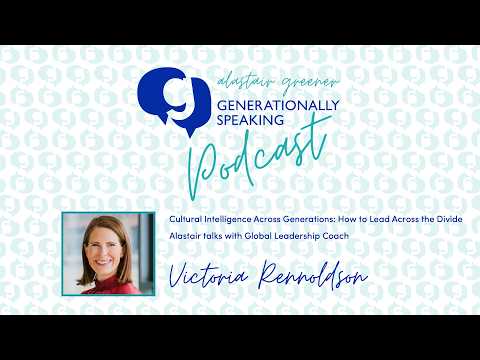
Alastair welcomes Victoria Rennoldson, a multi-award-winning global leadership coach, international speaker, bestselling author, and podcast host specialising in strategic communication and cultural intelligence. A cusp Millennial who began her career at Boots before founding her own business, Victoria now works with leaders and organisations worldwide, helping them navigate the communication challenges that arise when different generations, nationalities, and organisational cultures collide.
In this episode, Victoria and Alastair explore what today’s multigenerational boardrooms are really grappling with, from the rise of younger leaders in their mid-30s, to the frustration of Gen Z employees who feel flexibility is applied unfairly, to the question of what actually gets people back into the office (hint: it’s not pizza Fridays or beanbags). Victoria introduces her Cultural Intelligence framework, explains why curiosity is the essential starting point for any cross-generational relationship, and shares what vulnerable, human leadership truly looks like in practice.
Victoria Rennoldson Takeaways:
- Cultural intelligence (CQ) starts with curiosity, genuinely wanting to understand someone’s perspective before drawing conclusions about their generation, culture, or values
- Don’t confuse generational labels with individual identity: see the person in front of you, not just the stereotype
- Younger generations expect their leaders to show a human side, vulnerability, including simply saying ‘I don’t know, but we’ll find out together’, builds far more trust than projecting certainty
- Hybrid working has become the primary generational flashpoint: flexibility must be applied equitably or it becomes a source of deep resentment
- What genuinely brings people together in the office is authentic cultural exchange (e.g., bring-a-cultural-dish events), not surface-level perks Leadership styles are shifting rapidly: organisations must equip managers to lead in flatter, more transparent, psychologically safe ways, not just promote those who did well under the old model
- Advising young people on careers: focus on passion and transferable skills, the specific jobs that will exist in 10 years are impossible to predict
Victoria Rennoldson Links
culturecuppa.com LinkedIn culturecuppa.com
Read the full transcript
Automatically transcribed, so there may be the odd slip.
Alastair GreenerHello, and welcome to the Alastair Greene Generationally Speaking podcast, where we look at bridging the generation gap by debunking myths, tackling stereotypes, and sharing practical tips on how we can build stronger intergenerational connections. My guest today is a multi-award-winning global leadership coach. She's an international speaker, podcast host, and bestselling author specializing in strategic communication and cultural intelligence. Today, we're gonna be talking about parenting Gen Alpha in the digital age, what she's observing in Gen X boardrooms, and how different cultures view age, experience, respect, and power. And then we're also gonna be talking about how we avoid stereotypes and see the individual, how cultural intelligence can help us bridge the generational differences. So a lot to be talking about, so I'm really excited to introduce my millennial guest, Victoria Rennoldson. Good morning.
Victoria RennoldsonHello there, Alastair. Great to be joining you here today. Thank you for the very warm welcome.
Alastair GreenerWell, we have got a lot to talk about, and I should say, as a fellow podcaster, I have appeared on your podcast, and we were talking afterwards and suddenly thought, "Actually, there's, there's a lot we can be talking about when it comes to generations," especially given your experience having Gen Alpha, uh, kids and also what you're seeing in the boardroom because, of course, Gen X are in a, in a interesting position right now where they're... A lot of them are in the C-suite, and they're now having to oversee millennials who are probably in a, in a bigger control position when it comes to the running of day-to-day businesses. Let's start off with you, though. Uh, tell us a little bit about you and whether you see yourself as a typical millennial or not.
Victoria RennoldsonThat's a really, really interesting question because I'm sort of on the cusp between, I suppose, end of Gen X, very early millennial. Um, and I suppose w- you know, the things I... when I was kind of preparing for this conversation and thinking about it, there's been so many different trends that have come in at different moments. So, you know, v- my kids find it absolutely flabbergasting that I didn't grow up with a mobile phone. You know, I only got a mobile phone when I was in my 20s at university. That was the first time that it kinda came in. When I started work, yes of course, I had email and I had, I had sort of, um, pretty much a, a lot of the tools that are being used today, but the fax machine still existed in the corner, and that was still being used for a few years. So- I see myself in this kind of transition time where, um, clearly there's been huge technological kind of, um, changes over a period of time from the early days of my working life all the way through to now and ongoing. And I suppose where I see myself in that generation is constantly adapting, constantly thinking about, okay, so how do we do things differently? How do I work now? How do we work now? So I think that's quite typical of people of, of my generation, my age. Um, and you mentioned I have children. Yes, I have two children who are sort of early teenagers, 14 and 12. In fact, 12 today on the day of recording. So happy birthday to her. And, um, you know, this is also very interesting, navigating the world of AI for my work, but then navigating the world of AI for them and, of course, navigating communication in the world of AI for my clients as well.
Alastair GreenerYeah, AI is gonna be a big topic of conversation. I feel it almost has to be a part of almost every podcast that I do now. Coming back to your Gen Alpha kids and, and I like the way that you talked about being on that cusp between being, you know, Gen X and, um, older millennial and things. Um, one of the things that people talk about with millennials is the life stages and those key moments like settling down, having a home and, um, and of course, we can get into the whole thing of whether people can afford it or not, but also then having children a- as well. And in that respect, would you say those, those later life stages for you or those, those key moments have been happening later in life? Would that be, would that be a fair assumption for you?
Victoria RennoldsonYeah. I mean, I suppose I didn't take a necessarily a traditional path. Um, so many of my friends, people that I knew, um, sort of took paths where clearly they went into careers, they, they followed sort of different career paths, but built up usually in one sort of career. They usually, um, moved company, yes, of course. Um, they might move sector, but effectively stuck with one career path. I think where I'm a little bit different is that- And it's the same actually for my husband. We sort of, um, took a tr- very traditional career path. Myself, it was, it was brand marketing. Um, I worked in very large, um, uh, food companies, originally healthcare, then food. I started on a graduate scheme, which I think these days is fairly rare to have these around, but, you know, was trained up, had brilliant training. Um, I started at Boots, um, in the UK, the retailer, at their sort of head office in Nottingham. Um, developed my career there, and I worked in marketing for 12 years. But where I did something a little bit different was that I le- what I thought was going to be working in corporate life forever, left that path, um, when my kids were quite young, and decided to set up my own business, and that was when I sort of went off on a bit of a tangent and did things a little bit differently. So of course, I have other friends in the entrepreneurial world, but I have lots of friends who stayed with that very traditional career path, building their careers, getting promoted, uh, working towards their g- their career goals and ambitions.
Alastair GreenerAnd what are you expecting for your children? Because obviously, you know, you're, you're guiding, you know, your youngsters, and it's not gonna be that long before they eventually wind up in the workplace. Um, but obviously the workplace is gonna look very different to the one that you experienced when you first joined it. So what sort of advice are you giving them? What are you st- you know, how are you managing their expectations?
Victoria RennoldsonI think that's such a brilliant question, and it's been very top of mind for me, because my son has just chosen his GCSE options. So in the UK, this is for exams that you do when you're 16. And quite honestly, you know, we ummed and ahhed. We were trying to really analyze. Um, we were trying to ask AI, you know, "What do you think?" Um, we... But what ultimately, what it came down to, and I, I felt quite strongly about this, you know, when I really, when I sort of, you take the step back, we cannot predict what those career paths are gonna look like. I cannot even predict what, if he decided, say, to leave school at 18 and go work, at that point, what, even in four years' time, what careers or jobs might be the right jobs for him then. So, what we came down to is, do what you enjoy. Do what you're passionate about. Do where you, do those subjects that really resonate with you because ultimately, those are the ones that you're going to do best in. Those are the ones where you're gonna learn something, get inspired, get interested. Are those going to be the direct bridges into your job or career? I mean, I, as I was talking to him, I said, "I don't think so. I don't think it's gonna be as traditional in the path as that I had open to me when I was at the same age." And yet, there is still that importance of learning, growing, being able to take out, um, skills that you can then translate into other areas, and that's the thing that I really came down to with this conversation. You know, doing what is something you enjoy
Alastair GreenerAnd your, your generation and older generations, you know, really had that decision to make, do I follow my dreams or do I follow what's gonna be good for my career, finances, and everything else? And in a sense, I guess that probably still, still applies in many respects, you know, for young people today. You know, where-- do you follow your head or your heart, if you like. You know, and a, a lot of parents, certainly of my generation, would be pushing their children towards, "Hey, but if you do that, you're gonna make a good income, you'll be settled, you'll be fine." And that following your dream wasn't such a, a, a, a-- that was driven by the youngster themselves. Certainly probably wasn't driven by the parent.
Victoria RennoldsonMm. Mm, I think that's a, yeah, it's an interesting observation, and I still think it exists. I think, you know, I'm, I'm sort of not, um, sort of blind to the fact that clearly I want-- I'm b- I'm ambitious myself. Um, my husband is. We're ambitious for our, our children. But I think it's really hard to know what it specifically looks like. Whereas I think in previous generations, you might have had parents saying, "Well, become a lawyer," or, "Become an accountant," or, " Do something that's solid." Um, "Do something that is gonna have a good career path and is effectively almost guaranteed if you get into it." I just don't think that's the state of play today, and I think the lack availability of graduate programs, graduate jobs that are out there, um, clearly there are traditional career paths still out there, but they're much more, uh, limited in, in terms of the openings that are there, and much more competitive. And I'm sort of talking to people, um, parents who've got slightly older children and, you know, perhaps parents in, who in previous kind of, um, eras might have said, "Well, go to university and then go get the job," they're really considering many other options such as apprenticeships and what, you know, whether it is or the right thing to go to university still or not. So I don't know what will come, uh, certainly for my children, but I think particularly because of the fact that I've ended up in also in a non-traditional career path, my husband has as well, he founded a business as well, I think it's very much that we're open-minded. You have to be in this era to recognize what was true for us in our generation isn't necessarily true for our children right now, and what is true even this year is not gonna be true even in six months' time, a year's time, let alone in four years when my son is leaving school.
Alastair GreenerAnd I'm a great believer in that the environment in which your children grow up in, i.e., having two entrepreneurial parents will have a direct impact on the way that they see the future of work. And let's talk about your work a little bit now, because one of the things that really got me excited when we talked before was your work in boardrooms and working with probably predominantly Gen X individuals and, you know, seeing-- I, I wouldn't call it a culture clash, but there's certainly a very different mentality between the Gen X boardroom today compared with boardrooms before, but also of their teams coming up through and their, the way that they have to respond. They can't be in those ivory towers anymore. They've gotta think differently. So tell me a little bit more about your work and maybe some of the challenges that being of a certain generation in those boardrooms, what that's throwing up.
Victoria RennoldsonYeah. So I, I sort of work with, um, organizations who are usually already very global, um, so multinational. Um, usually working with, um, a sort of team or a, a small group of senior managers, uh, from that organization thinking about cultural intelligence, um, leadership, and communication, strategic communication. And what is interesting is generally, you know, if we come back to the generations, they're probably the younger side of Generation X, most of them. Um, some of them are even are Millennials. So there is a little bit of a shift kind of going on, and what I have noticed is it's not as it kind of was perhaps when I first started my career there. It was dependent on your experience and the number of years that you'd notched up, and that meant that you then earned the opportunity to get to the, the next level, the leader level, the, the kind of board level. I think there is much more flexibility, um, and open-mindedness to, actually it's not about how many years have you done, how... You know, yes, of course, experience matters. But actually really giving opportunities to much younger, uh, people to really show themselves, to demonstrate their leadership. So working with leaders who are... I'm often working with leaders who are also in their mid-30s, mid to late 30s as well, not just leaders who are in their 40s or 50s or, you know, beyond, and I think that is interesting. But I think the kinds of conversations that are going on in those boardrooms and the kinds of conversations, the kinds of topics that are coming up, particularly in my world, are often about, you know, how do I be a leader today? What does that mean and look like? Because I think that people have the perception of what it means to be a good leader in themselves, and that's based on their own experiences, what they saw in their own career journey, and what they believe is their natural leadership style. But then there is the question: what is it that your team expects of you as a leader? And that can be quite different. So the kinds of topics that come up include things such as being transparent. How transparent are you being? Um, how- Um, direct or indirect are you being? How, um, you, how power is playing out, whether it's about a flatter organization and being very, um, feeling like there's no kind of hierarchy in that sort of team, or whether you're creating positional power and perhaps either directly or indirectly demonstrating that. And these are the kinds of questions and topics that are coming up, including things, by the way, like, um, psychological safety, of course, um, inclusivity. You know, how are we making sure that we're hearing from all the voices? And I think these are very different conversations that you might have heard even 10, 15 years ago in the boardroom. I think this is the interesting thing for me, and where I come in with cultural intelligence piece, is really helping people to understand their different ways of adapting their leadership, what it is they can do to be more connected to their people, rather than, as you say, in their ivory towers.
Alastair GreenerAnd that, that is a generational thing, isn't it? Because in, in so many respects, because again, those older board members are going to have quite a different perspective to the younger board members. And yes, that's always been the case. But, you know, I always say that, that I, I saw the, the biggest shift actually between Gen X and millennials. People always talk about being millennials and Gen Z, where my theory with that is that actually Gen Z, a lot of what people are talking about is actually a life stage, um, element. And culturally, I think they're far more aligned to millennials than millennials are to, um, Gen X. Um, I think there was a, a big shift at that point, and a lot of it comes down to communication. And obviously in my studies and surveys and all the things I've written about in my book about the way that different generations communicate is so critical to the success of a company. So what are the sort of channels that you're seeing that are working for those boardrooms to communicate effectively so that they have the transparency that you were talking about?
Victoria RennoldsonAnd again, I think this is where we have to then overlay other types of culture that goes on. Because what I find is I'm working across sectors, um, I'm working across, um, yes, multinational organizations, but they often are from one culture originally. So, for example, I'm working with a very large French organization right now, but multinational. Um, sort of last year working with a Swedish one. Um, so when you overlay other types of culture, national culture, um, you know, individuals, are they very much from monocultural or are they very diverse themselves from many different backgrounds? Um, when you overlay things like not just generation, but things like even religion, ethnicity, um, um, all these things, all these factors, and there are so many more aspects of our cultural identity. This all shapes how the, uh, teams and organizations are working. So, for example, there are some sectors and some areas like law, finance sometimes, it depends which sec- which part of finance, um, sometimes even construction, which are quite sort of top-down communication, where there is a sense of, you know, this is, uh, the top person, the decision maker, they are making the decisions, and then that communication kind of flows down in that way, and it's quite broadcast. I work with other industries where it's a little bit more what I call two-way dialogue. So there is a lot more kind of communication flow, and there's a lot more listening and a lot more, um, openness to how that communication flows, and actually a bit more spontaneously as well, rather than in these kind of very structured channels and certain specific times that they come through, like town halls. So I think that is also overlaid with, with that kind of generational culture. But certainly, my sense is, is that with the younger generations that I work with, that there is that expectation of transparency Of knowing what's going on, of being included in the debate, of wanting to be heard. I talked about hearing all the voices. You know, I think people don't want to be, uh, the youngest and least experienced person in the room and just sit quietly and make notes. That's not true anymore. There is a sense of they want to learn, they wanna ask questions. They're curious, like why was that said in that way? And I think that's positive actually, 'cause curiosity is a core part of cultural intelligence, the work that I do, that I talk about in my book. And, you know, for me, this is something we, we actually all need, not just any-- that generation, but all generations, to be more curious, to ask those questions, and actually to be more curious about each other, in fact.
Alastair GreenerAnd it's really interesting you talk about that because, you know, you, you brought up two things there that I'm, I'm very much an advocate of. The first one is the fact that, um, you know, what the young do today, we will be doing tomorrow. So in other words, this whole thing of transparency, actually older people we're seeing are now looking for that transparency because that's what th- that's the way things are going. So, you know, it might have been established as a pattern by young, but actually older people are looking for it. And then of course, the other thing is that Gen Z and the younger generations have been told, it's been part of their culture to ask questions, and they've been told, "You will be listened to," because they are being listened to in the home. They are being listened to in school. So that's creating a very different dynamic when those same people reach the workplace. And if you've got some Gen Xers and older millennials who are not maybe in tune with that, then you can get a bit of a challenge. So are you finding any pushback from, I would say probably more the, the more senior members of the board and older members of the board, or, uh, actually across the board? Are you finding any, any pushback, any resistance that you're having to work with them to show them actually there's a real benefit to show that curiosity?
Victoria RennoldsonI, actually, interesting, no. I think in, I think actually it's seen as a positive thing, a positive, um, idea that's coming into the conversations, into the workplace. So personally, I've not seen that. I think where the resistance points come up, and the sort of friction points come up, are actually m- less about that, in fact, but more about, um, working styles, and this whole question since COVID about hybrid remote working. And so I think there is a, and, and again, I don't wanna generalize, but there's a general sense of, "Oh, those, those younger people, they don't wanna come back in the office. They just wanna work from home or have the flexibility." And what I'm seeing with the organizations I work with is more of a drive to bring everybody back to work five days a week, get everybody back in the office. There is some flexibility in some organizations. Some are still maintaining that three to four days, um, in the office, one or two days at home. But I get the sense that the other trend that I see is that those younger generations do not want to be straight-jacketed into a particular way of working, i.e., you know, I, when I started work, it was very normal. You knew you had to be in the office five days a week, and you had to be in with these hours. And those hours, um, I think probably were specified once or twice, but it was kind of you just conformed. I think actually there's much more of a sense today of, um, particularly for those younger people, like, "I wanna work in the way that suits me. I want that flexibility," whether that is about flexibility every week or every day, or even to have flexibility to do things like, um, travel more or to be working from even different countries, different locations. And I think that sometimes is the friction point where some of the Gen Xers, some of those millennials are like, "Well, we just need to bring everybody back into the office. We need to be together. We need to bring that team spirit." Um, and so that can be the challenge that sometimes comes up. And I, um, if I may, there was a story, I, I sort of was talking to, to a millennial recently, um, talking about this question of flexibility, and her point of view was, um, actually sometimes flexibility is weaponized a little bit as well, which is interesting. So she was kind of saying that there was a, a particular person, a parent, who needed to leave at, uh, 2:00 PM each day to go collect their child, and of course, that was absolutely fine. But somebody in her team who was younger, who asked to have flexibility to start later because they wanted to go to, uh, to the gym and exercise, and that was their best time, was refused, and that kind of flexibility was seen as not acceptable. So that's an interesting question. You know, is flexibility for everyone, or is it just for some people in the team? Is there acceptable flexibility? Yes.
Alastair Greenerwell it's harder being a manager today than it's ever been in my view, because you've got to navigate all of those different requests and different things. And then you also then have to look at the individual and think, "Well, actually they're, they're providing great value to the organization, so therefore I'm going to allow that flexibility." But then there's the other thing of whether an organization is mandating people to come back in or whether they are creating... I'm, I'm working with an organization next week where they have deliberately created an environment where people want to be in the office. And I think if, if you do that, you, you set a very different standard. Um, I mean, I do work with organizations who are mandating, but I think as you said, you, you get a little bit of pushback from those, especially younger people who, who seek that flexibility. And the very good chance is they'll go to those organizations that give them that flexibility. But if you create an environment whereby people want to be in, then that's a whole different ballgame. So are you seeing, you know, what, where's the balance there from what you're seeing between mandating and b- creating the environment where people would want to come in?
Victoria RennoldsonI think that's exactly the point for me, but I think there's an important differentiation. It has to be more than gimmicks, because I think that's seen through quite quickly, so it can't be just, "Oh, it's... Oh, we've got fruit," or, "We've got, you know, um, sort of pizza Friday." I mean, yes, of course these things are nice, and they can be positive experiences. But for example, you know, I was talking, um, to somebody who was talk-- saying that they were creating cultural events at the office, where people were bringing in their cultural dishes to understand each other's heritages and the cultures they identified with. So they came together for a, um, food experience, to enjoy food together, to get to know each other, and that's much more meaningful. That's much more than surface level, like a gimmick, come and have pizza on a Friday. That's truly about bringing people together to connect, and that is the kind of experience that organizations, workplaces need to think about. So that's the first thing, experiences. The second thing, I think it is also about, um, making sure that there is learning experiences, learning opportunities, and that's another very good motivator to come back into the office.
Alastair GreenerAnd of course, these are all coming from the top. If you don't get the buy-in from the C-suite, then it's not gonna happen. And, you know, and I, and I absolutely agree with you, it's more than beanbags, pizza, and table tennis tables. You know, it, it, it is creating that culture, which let's be honest, is hard work because you're having to think out-- think differently. I was about to use a terrible cliché then. But you know, you have to think differently when you do that and listen to what your, your teams want. But then hopefully you get that higher level of engagement. You know, when you look at the Gallup engagement, uh, statistics every year, it's, it's quite shocking how little, um, people are engaged, and especially in, in, in the UK. So what kind of advice are you giving to your, um, Gen X and, and, and millennial, uh, C-suite to get that engagement to be stronger? And we all know that engagement means higher productivity, less attrition rates, and so on. So what advice do you give them in, in your, in your workshops and in your training and consultancy?
Victoria RennoldsonSo I think, you know, I, I've talked about cultural intelligence a couple of times today. Um, very briefly to explain the approach to it, it starts with curiosity. It's about understanding what motivates people, what drives them, what, what is interesting to them. And I think that's a real listening exercise, really understanding what is work to those people, to your people? What is it that's really going to motivate them to do their best work each day? That has to be the starting point. Then you have to kind of gather the knowledge, be asking the questions, be really understanding. But then it's translating that into strategies, really, and treating those strategies not as fixed, um, strategies you stick with forever, but almost a series of experiments, working out what it is that's really gonna connect people, bring people together. But, you know, some of the examples that I kind of gave earlier, this is about really deeper human connection. It's more than just turning up for, um, a quick kind of grab a bite. It's really about people getting to know each other, um, understanding where they're coming from, really knowing more about their personal lives as well. And the more that I, you know, workplaces create this, the better it is. And again, if I come back to the generational point, those younger people are expecting to see the human side of their older leaders. They're expecting to see them being, um, I know sometimes the word vulnerable is not a word that people like, but more vulnerable. And that can be as simple, by the way, as saying, "I don't know the answer in this que- in this situation, but we're gonna work together to find out." Um, it doesn't have to be, vulnerability doesn't mean bursting into tears necessarily, or sharing all of your personal life. It is about sometimes saying, "I don't know," and that's okay. So I think these kinds of, um, I'm very passionate about the human experience. Um, I think this is a core and it, it's a very core part of my book as well, because ultimately, yes, the AI skills are needed, but human skills are needed, and this is gonna make the difference about bridging between generations as well.
Alastair GreenerYeah, you've, you've hit the nail on the head, and actually I want to finish up al-already, I'm afraid. Uh, but finish up about that bridging and how you do it, because one of the things I know is that, you know, you help your, um, neighbors and friends, um, who are, you know, your, your, your kids' parents sometimes with their technology and things because you're running your own business, you have a different sort of perspective. So I, I'd like to finish off, if I may, by asking you to give some top tips. First of all, how do we connect better with those younger generations? I'm talking Gen Alphas. You know, to have that relationship between the, the, uh, parent and child that is, first of all, appropriate, that you're still guiding and you're teaching, but you're also, you know, learning from them, and you're understanding where they're coming from. So what kind of advice are you giving to, um, to, to people that you know beyond just technical in terms of from your experience, maybe they've got younger Gen Alpha kids than you, so you know, how, how they navigate that path. What kind of advice are you giving them?
Victoria RennoldsonWell, I mean, look, I mean, I'm not an expert in that field, but I think what I would love to say is that, you know, for me it's, it's always about curiosity, which I've mentioned, I know I've mentioned a few times today. We, we, we can make all sorts of assumptions and be quite absolutist in our language. We can say, "Oh, they are always like this," or, you know, "That generation operates in that way." And of course, I do know there's very good research out there that gives us the averages, and I know you've done fantastic research behind this, Alastair, as well. But then we have to see the person in front of us, the individual in front of us, and recognize that, yes, they may be typical of their generation or they might not. They may have other influences on who they are and how they show up. Culturally, there might be a whole lot of reasons why they're operating, working, um, uh, speaking, communicating in the way they do. So, to understand that person, rather than assuming that you think you know what they're about, get curious, ask the questions, and ultimately, that is the great starting point for any conversation, whether we're talking personal, uh, family life, school life, or work life. That is gonna be the best mindset, I think, for anybody listening to this podcast.
Alastair GreenerAnd actually, that applies completely to business as well, um, when you're talking about intergenerational teams. And interestingly enough, my five-step model that I use in my book and in, in my workshops is the first word is curiosity. You know, being curious about different people, asking those questions, getting them involved. That's great. So last thing, working with your, with your boards, um, with Gen X, with different generations and things, what are you-- You, you've talked about being curious Absolutely agree with that. There's no question about it. What other piece of advice would you give to boards to increase engagement to get that, you know, that bridge to be effective between generations?
Victoria RennoldsonI think it, it ultimately it comes down to be, to listening, to asking the questions, making the time, which often doesn't feel like there's space to do this. But this is kind of a really key part of, um, really understanding what is needed. So having those direct conversations in lots of different formats and ways, um, from large group to small groups to individual, and really just getting a pulse. Um, yes, I think anonymous surveys are great. People obviously sometimes share more deeply when it's anonymous. But honestly, I think having those conversations is the most, is, pays dividends. And I always kind of say, like, you know, pay attention to how you design those conversations. If you invite everybody into the boardroom, uh, from lots of different generations to talk about things, you may not get the same conversation than if you said to somebody, " Right, shall we go for a quick walk, maybe two or three of us together, and have a conversation about this? Let's just go out and grab a coffee outside." Sometimes you have to intentionally design the environment to have those conversations, to really hear more about what's going on and how to engage and connect better.
Alastair GreenerThat's great advice, and I love the concept of making sure you find the time, you make time to have those conversations. Victoria, it's been absolutely fantastic talking to you. Um, I've got some lovely pearls of wisdom there, which I know that, um, listeners will really enjoy. And, um, the, uh-- and what I really liked was the fact that those are tools that are really applicable probably wherever you are, certainly in your work dealing with boards. But I think in, in any way, there's a lot of really good strong tips there. Um, we're gonna put all your details in the show notes so people can get ahold of you, follow you, get your book, and also listen to your podcast as well. Uh, so I wish you all the best with that and with all your work. Uh, thank you so much for being on the podcast. And thank you for joining us as well. We'll be back in two weeks with another podcast. Bye for now. The Alastair Greener Generationally Speaking Podcast was presented by me, Alastair Greener. It was recorded at Granary Studios and produced by James Jones. Please follow us and leave us a review wherever you get your podcasts. To find out more, visit generationallyspeaking.co.uk.