
Podcast · Episode 13
Paul Hargreaves: Purpose Before Profit: Building Ethical, Multigenerational Workplaces
Guest: Paul Hargreaves, Chief Executive, Cotswold Fayre, and B Corp leader. Host: Alastair Greener.
Audio
Video
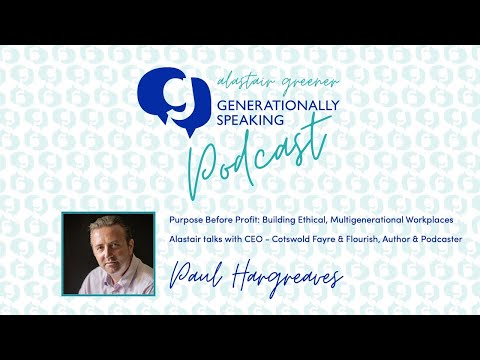
In this values-driven episode, Paul Hargreaves, B Corp leader, author, and CEO of Cotswold Fayre, talks with Alastair about how purpose-led businesses are better for people, planet, and profit. With years of experience leading ethical enterprises, Paul explores how different generations approach leadership, legacy, and social responsibility. He reflects on his Gen X upbringing and how it sparked his passion for fairness and sustainability. Paul also delves into how younger generations are holding leaders accountable and why that’s a good thing. From his advocacy for conscious capitalism to his insights on neurodiversity, humility, and mentoring, Paul lays out a powerful vision for a multigenerational workforce united by shared values.
Paul Hargreaves Takeaways:
- Why the best leaders are now “generous leaders”-collaborative, humble, and inclusive.
- Gen Z is driving transparency and social impact-and that’s reshaping business
- priorities.
- Diversity (of age, thought, and background) fuels innovation and culture.
- Leadership isn’t about hierarchy-it’s about human connection and purpose.
Paul Hargreaves Links https://www.linkedin.com/in/paulwhargreaves/ https://www.instagram.com/cotswoldpaul https://www.tiktok.com/@paul_hargreaves1 www.paulhargreaves.co.uk Podcast: https://podfollow.com/4th-bottom-line
Read the full transcript
Automatically transcribed, so there may be the odd slip.
Alastair GreenerHello, and welcome to another episode of the Alastair Greener Generationally Speaking podcast, where we look at bridging the generation gap by debunking myths, tackling stereotypes, and sharing practical tips on how we can build stronger intergenerational connections. And the person I'm talking to today, my guest knows all about different generational connections, uh, with his work. Uh, he's the CEO of a wholesale business, COTS world fair, and a retail and restaurant business flourish. His company was one of the first B Corps in the uk and we'll talk a little bit more about that later. And he. Passionate about sustainability and cultural transformation in organizations, which has led him to writing two books, speaking to other businesses, and mostly reaching, recently launching a podcast. So I'm, I'm here with an expert podcaster. His is called the Fourth Bottom Line. Uh, Paul, it's wonderful to have you on the show. Thank you very much indeed for joining me. Yeah, thanks for having me and look forward to the conversation. Well, we've got a big conversation and you know, first of all, Paul Hargreaves, generation X. Do you see yourself as a typical Gen X or do you think you break the mold?
Paul HrgreavesI think in terms of, uh, gen X is a well known for working hard, um, not taking any prisoners, um, being resilient. And I think those characteristics are what you need if you're a entrepreneur. It's not a word I'd probably use about myself that much actually, but I guess I am an entrepreneur. Um, and I, I, I know a lot of entrepreneurs in my generation, so in that respect, yes.
Alastair GreenerSo what, what about your upbringing? Did you have a typical Gen X latchkey kid upbringing?
Paul HrgreavesY Well, yeah, I mean, my, both my parents were doctors, so they weren't around too much at home. In fact, I was just talking to someone the other day that most of the time my parents had no idea where I was. Certainly, obviously when I was younger they did, but, uh, when I was a teenager we were pretty feral. Um, and I, I grew up in Manchester. Yeah, just I used to mess around in the, in the center of the city with, with a friend and get up to all sorts of mischief. Um, some of it leaves. I, I think you're probably
Alastair Greenerlike me, you are very grateful that social media wasn't around in those days to capture those moments.
Paul HrgreavesAbsolutely, yes. Yes.
Alastair GreenerWell, I, I can certainly relate to that as a, um, I'm, I'm not sure my parents would like to say that I was feral, but we were very much left to our own devices and yes, but I was very different. I was on, on a farm down in Cornwall, so it was a very, okay. Very different upbringing, but actually similar framing, um, in, in that respect. Yeah, probably. And what about as, as you were growing up, you were, you know, obviously growing up in the, you know, eighties. And that stuff was a pretty iconic time in, in many respects, where there was a huge evolution of thought. What was life like for you growing up in that era?
Paul HrgreavesYeah, well it was probably, you know, seventies. I was born in 66, so a lot of my growing up was probably late seventies. Went to university, mid eighties. Um, goodness. What was it like growing up? I think look, the big, the big thing for me was, uh, again, probably connected to my parents. I, it took me a long time to, to kind of work out who I was. Um.
Alastair GreenerI, is there any pressure to do a particular, go down a particular direction with your career I being a doctor like them?
Paul HrgreavesNo, that's, yes, there is. There quite often is isn't there with, with doctors, but I think they were both so disillusioned with the health service at the time. They. They were almost discouraging us from doing that. So one or three, none of my, neither of my siblings went down the medical route either. I did actually do the right A levels to to, to go down that route, but must have been persuaded away from it. In the, in the sixth form at school. So yeah, I mean, there was a huge value placed on academic performance. Um, I remember coming back home with my A level results, which was, I'm not. I'm not posting here, but I got three A's, but then I also did a a an S level. I don't, I, they probably don't exist now, but, uh, I got, I didn't get the top grade in the air, so my dad said, what one went wrong there? Hang on a minute. I got three A's, what's your problem?
Alastair GreenerThat, and isn't that a difference in the way children are brought up in the, where the focus is? And that we're taught today to bring up children in a way that's far more celebratory of the achievements rather than focusing on what wasn't perfect.
Paul HrgreavesYeah, absolutely. So yes, it did make, having said that, you know, the reason there are entrepreneurs, um, disproportionate number of probably my generation, is it, it does create drivenness. So. Which isn't great, but obviously there is a good side to it. I think, um, the way probably I brought my kids up is, um, they're less likely to be entrepreneurs than, than I was. So this swings in roundabouts, isn't it?
Alastair GreenerNow you've, you've got millennial children and Gen Z children, and some people suggest that Gen Z who are the, the majority of Gen Z are, um, gen X kids of Gen X. And some would suggest that they actually have that. Entrepreneurial spirit, partly with the side hustles that we hear about and so on, but it's, but some of that actually comes from their entrepreneurial Gen X parents. What would you say to that?
Paul HrgreavesWell, currently, just based on the very small sample size of four, um. No, no, none of my children are looking like they're gonna be entrepreneurs right now. But having said that, there was one, I mean, one, one of mine is, is um, is on the, the spectrum actually. And he, he, he did show signs of being an entrepreneur when he was a kid. Um, so got a phone call one day when he was at school, and basically the tone of the teachers, I knew something was. I thought, oh no, what the hell has he done? You know? And what it was, was that he, he was about buying sweets in pound land, I think. I think he was get, he got his sister to go and buy the sweets in pound land, and then he was selling them, uh, on the, on the bus. Back from school or to school at an extortion amount of profit. And he got, and he did this for a while without getting rumbled, but um, yeah, one of the teachers obviously found out about it one day and, you know, was expecting me to condemn him for this. Um. Dodgy behavior and I said, well, I think it shows good signs for the future. Actually, I don't think he was that, well that,
Alastair Greenerand that's a really, that's a really interesting thing, isn't it? Because half of you would want to say, oh, exploitation, that's absolutely shocking. But then the other half thinks, Hey, fair play. That's a bit of an entrepreneurial flare.
Paul HrgreavesHey, exploitation's a bit strong, but can a 50% profit margin on their, on retail prices is, it's probably a bit excessive.
Alastair GreenerNow that links very, that, that, that links very well into, into what you are doing now. The fact that, you know, your, your focus is on sustainability, on cultural transformation. What, you know, for somebody who was this Gen X cutthroat business kind of entrepreneur, I'm not saying you were, but that's the the impression we get of that generation. So tell us a little bit about the path that got you to the point where you are now.
Paul HrgreavesYeah, well, I'm, I'm very much not that person actually. 'cause for, for 12 years I worked in the charity sector before I even thought of running a business, I did, I, I've only actually been gainfully employed for three years of my life. And that was in sales in straight Outta university. I worked in, uh, sales for three years, then went into the charity sector, working in the inner city with drug addicts, people who, uh, spent most of the time in prison. Um, kids who were just lost, uh, and old people as well, actually. So we had a team of people working in a place called Deford, which is, um. In, in the, it was near Greenwich, but it's, it, it's, it was nothing like Greenwich. I think it's been gentrified now, but it was, you know, there was 68% single parent families at the time, virtually zero car ownership. It was a desperate place. Loads and loads of crime. In fact, some. Parts of the area the police didn't go to because there was so much crime, it was outta control. So I, that was funded by various, um, donations from some of the rich friends that I made at, uh, Oxford. They felt guilty about going to the city, so they contributed into this trust that was doing something more useful than they were. Um. Eventually those funds dried out and I had started a side hustle of, of the business, um, to help make, help feed my children. Um, and in effect, that took over and there became a point in time, which happened to be 1999, where I decided to actually start the business properly rather than it being a, a side thing. And so I was very much coming from. The world is a mess. Um. Some of the reason it's a mess is business. Some is government, local or national. So right from the start of the business, we wanted to give people a chance and uh, the first, I think three of the first five employees were people that were. Would be described as unemployable by others. So one was straight out of prison, one was a recovering heroin addict and one was a recovering alcoholic. So right at the start of the business it, it was within the DNA was, this isn't just to make money, it's to try and do some good in the world.
Alastair GreenerAnd what, what do you think drove you, because that certainly is not the stereotype of a, of a Gen X in terms of, you know, your career path and clearly going from something like sales, which is a bit more cut and thrust, um, and more stereotypical eighties. What was it that that drove you to go into the charity sector and to do the work that you did?
Paul HrgreavesYeah, that's a good question. Um, I, and when I'm very competitive, I used to do a lot of sport, getting a little too old for that now. But, um, so the, the competitive side has always been there, but at the same time, I've always had, and I've, you know, have kind of done a bit of work working out where this comes from. I've always had a very keen sense of being upset about injustice. So back to the upbringing actually. So we lived in a, in a nice suburb of Manchester, but just down the road was the largest cancer state in, in Europe at the time. It, it won't be now, but a place called Shore, which is where the, the royal family is based, if you remember that. Um, probably old enough. Um. In fact, Caroline Hearn went to the the Lex Primary School to, to mine. So I was always very aware that I was from a privileged background, and it was obvious that, um, I was much luckier than many people who lived, uh, near me. So. And I, I've probably got, I dunno why, but I, that upset me as a kid. So yes, that's one of my drivers and has kind of flowed through. I. A lot of what I've done in my life actually, uh, wanting to make the world better, primarily in the, in the kind of people area, uh, initially and then more recently in the environmental area, which obviously affects people. You know, climate change is, is killing people in other parts of the world already and will only get worse. So yes, there has always been a compassionate side with within me.
Alastair GreenerYeah. And it's, it's always interesting to look at someone's upbringing and what framed them in terms of things that happened in their environment, uh, growing up and for you to see that injustice of nearby, um, people not having what you have. Mm. And it's, it, it's interesting though that you. Noticed it where others may not have noticed it. So there may be something more in your DNA that also it, it, it, it was a, a trigger for something that was already there. But, but looking at, at your, the way that you work now, the fact that you are giving people remarkable opportunities that they might not otherwise have it, is, is that still all stemming from that injustice that you saw when you were younger?
Paul HrgreavesUh, yeah, the, the, the golden thread is, is, is definitely there. I think probably very naive at the, at the beginning we tried to do too much too soon. Having 60% of your employees, uh, of the initial five was. Was too much. Uh, the business wasn't sustainable, probably financially, which is, uh, never great. So yeah. And, and coming onto the, the B Corp. So when I, um, ran across B Corp, um, so, so started off the business for a couple of years, ran it with another guy actually, and we very much along the lines we've, we've just talked about, he then left 'cause desperate. Financial situation. Um, so for the next probably, well 12 years or so, I was kind of bumbling around, lost that kind of sense of purpose that was there at the beginning, really was just focusing on having a viable business. Um, so when I did Discover, heard about B Corp, which was in about 2014 from a a another CEO, um, in the food sector. Uh, apart from thinking the name was a bit American, I did, uh, dig into it and realized that, oh wow, this is everything I ever thought business should be about. And here are some people that are doing it a lot better than I am, uh, at the time, mainly in the states. Um, and not only were they making a difference to the world, they actually had successful businesses too. So yeah, we dived straight in and we were one of the first, um, there was an initial kind of cohort of 40 B Corps that founded the, the UK movement, and we were, we were one of those 40.
Alastair GreenerSo just for those who aren't familiar with B Corp, maybe could you just encapsulate what it is?
Paul HrgreavesSo in one sentence, um, there are businesses that put people on planet before profit, um, in three sentences. Um, there's basically three things they have to do. One is legally change their articles of association. That's the documents that are held on company sales. So legally, those businesses, typically businesses exist only for one purpose, and that's. The shareholders and shareholder primacy is why we've businesses generally have made a, a mess of the world when there's only one motivation. That's to make shareholders rich. So they've gotta change that. So their business exists for the benefit of all stakeholders. There's a fairly rigorous, um. Certification process, which looks at the areas of governance, environment, customers, community and workers. And you have to get over a certain, uh, score in, in that. And then finally, uh, once you are a B Corp, you have to produce a, an annual impact report. So in a nutshell, uh, that's it.
Alastair GreenerAnd what was the response from, first of all, your customers, but then your employees when they discovered that you were aiming to become a B Corp and then when you achieved it,
Paul Hrgreavesum, customers not interested at all. Uh, at the time. There's, there's many still aren't actually, but there's, there's more that are, um, most impact initially was, was workers. Um. You know, like me, it took them a while to, to get it. And I would say it probably took us two years, maybe three, to kind of embed those values properly in the business. Um, and then suppliers more so, I mean, it would happen in the food and drinks space. There is a higher percentage of, of B Corps than any other sector actually. So, um, I mean we, very few, I think maybe two suppliers were, were B Corps. No one, I think it was only one before we were, so they were part of that original group. There was one customer, um, cook, which is the frozen food company now. Uh, we have over 80 suppliers that are B Corp. So yes, we are attracting those into us. And now, um, you know, there was initial kind of transformation process, but now people, generally, a lot of them come and work for us. Because we're a B Corp. Um, because it's, it's, you know, it's a bit more well known now than it, it's a lot more well known now than it was in 2015 and the last three years. And how
Alastair Greenermany employees, how many employees do you have now, and how easy is it to keep a handle on it when you grow and when you get bigger?
Paul HrgreavesSo we, we have over 150 employees. Um. The wholesale business, which is the, the main kind of financial driver of the, the businesses is only about 40. Um, and in 21 we started this, this retail side, which we call it food hall and kitchen, it, it, other people call it. A farm shop. It is a shop on a farm, but it's not a working farm. It's technical definition. But, um, I was particularly interested to, to start that really with everything I'd learned in the, in the previous 22 years, starting a business again and putting that stuff in right at the beginning. Uh, it wasn't the only, only motivation for doing it. I thought we could do a really good job at Sam being a great place to buy food and eat food on site, but I was. The challenge was to start again. No common people could we. Be better right from the beginning. Um, and, and you know, it's obviously a long story, but the answer was a resounding yes. And it was primarily because we've been a lot, become a lot better at articulating, uh, values and making it clear what we were about. And we just attracted a load of great people into the business, which mainly were millennials and, and Gen Z.
Alastair GreenerSo, yeah, let's talk about them because they are very different. I mean, okay, yes, they're the same as your, as your own children. Um, but somehow we view our own children somewhat differently to we view other people's children. So how did you. Get on with the different generations. What were the, what were the positives and, and what were maybe some of the challenges that you experienced being a Gen X?
Paul HrgreavesI think with, so with that business, you know, the wholesale business, um, there's hardly anyone in the, this office today, just before Easter, but, um. When you, when it's busy, there's just people sitting in front of screens. With the retail hospitality side, obviously most people's job isn't sitting in front of a screen. It's do, it's interacting with customers and when you are with your colleagues. So I think in many ways it's much easier to kind of pass on. The values of a business when it's, there's a lot more human interaction, and I think it's a lot easier for those younger generations to catch and to get what we're doing. I mean, an example is actually my own children who don't work there, but they, you know, as, as you do if you're a business owner. And, uh, when, when they have, you know, part of child minding is to take them into the business and make them do something useful, which, um. We used, I used to do it Christmas, particularly when we were making up hampers, and some of them were better than others at, at doing that. But it, when IO when we opened Flourish, which is the, the retail side, and soon after that, I think three, three of them came for lunch one day and it, it was like suddenly the scales fell from their eyes and, oh, dad, we get it after all this time. They got it just from the interaction of the people and how people were in the business and how the, the service was. So I think it's a lot easier to catch those values when you're in a, a business where humans are interacting with each other than it is when it's, um, basically just sitting in front of the spreadsheets all day.
Alastair GreenerSo a, a couple of things come outta that, that I'm thinking of. One is, what's your view about working from home and having people work in a hybrid environment? And then, well, I'll come to the second in a, in a moment. So what's, what's your view on, on hybrid working?
Paul HrgreavesUm, yeah, so we, we to, people are in the two days a week currently. Um, I am thinking of, well, we are thinking of increasing that. Um, so I. My view on hybrid working, it's great for many people. Obviously, those with, with children, particularly pets, et cetera. The people that have struggled with hybrid working are those who, the younger one. Um, there's a 19-year-old who's just started working here, actually. Fantastic lives with her parents. Um, but I know she much prefers to. Be in the office than, than working at home. I think, I think both her parents also work at home, so you can imagine it gets a bit crowded. So, um, yes, I, I, we doing it because. The pressure's there to do it. I, um, I think we need a bit more collaboration time and there's some days, like today when there's just not enough people here to, to make it work, other people worthwhile coming in. Um, so we have one day that everyone has to be here, which is Tuesdays. So that's your kind of big collaboration day. And then they, they can choose another day. The office is shut on Fridays. We do though, um. Before we brought in the must be here on Tuesday's rule, um, we, we'd have one day a month where it, it is called a company day where there's less, there's no pressure to, I mean, some people have to do stuff obviously, but there's less pressure to work. Which I put in inverted commas. 'cause I think interacting with your colleagues is, is work. But um, there's no pressure to produce. You can go out for long lunches, you can go out for coffee and we always have, one of our suppliers always cooks us lunch. And that time there's normally some kind of fun activity as well. There's a longer meeting so we can communicate. Better. So I think all that stuff is just done much, much better face-to-face. So I mean, personally I, because I shared childcare, I've always been hybrid. Actually I always worked at home Tuesdays and Fridays. I probably didn't, um, didn't allow the other people in the team to do that for some reason. But, um, so, yeah. Um, I think, you know, for certain jobs. There is a time we need to get your head down, just focus and in a busy office. And there, there's a lot of laughter and fun here. It's not always easy. Um, and we have quite a few neurodiverse people in the business, particularly for them. It's not always easy to focus when you're in a, a busy office. So I, I think a hybrid model is, is the best of many worlds.
Alastair GreenerYeah. And, and a lot of it as you, as you say, those horses for courses and, and very quickly the other aspect of your business where you are dealing with retail and that involves interactions between individuals and, and so on. Mm-hmm. You know, again, we hear Gen Z, that's not their forte, that's not their strength. What would you, what would you say. To that.
Paul HrgreavesYeah. So obviously what I just said about hybrid is only in the wholesale side, the retail hospitality. You can't work in a kitchen from home. Yeah. So everyone is in all the time with that business. It's a very important point there. I I, I wish schools did more on this because it's, so, one thing I have noticed is that, um, those younger generations you say, have you. Have you, um, spoken to so and so? They said, yeah, yeah, yeah. I've spoken to them. They haven't, they've just sent them a message or drop 'em an email. They haven't actually spoken to them. So it, because yeah, you're right. The, we're not equipping people to have those proper human. So in many ways what we're doing in the, the retail business that is a lot of it is to deliver good service, you gotta talk to your customers. And we have incentive schemes to, you know, people that get shouted out in, um, reviews, uh, by name, get rewards and, and stuff like that. But yes, the, the team that worked there, a lot of their time is, is taken in developing. Those proper human connections because you can't be a good retailer or a good restaurant without that.
Alastair GreenerYeah. And, and obviously you are doing a fantastic job at training and to pick up the slack where maybe the education system isn't providing that. Yeah. And, and, and one of the things,
Paul Hrgreavessorry. I was just gonna say Yeah. So Carry on it. It is, I mean, the most encouraging thing for me really is when you see a. A review or you hear a conversation and people are noticing that difference. That is, wow, okay. It's working. Brilliant.
Alastair GreenerOne of the things that we hear all the time is that it's Gen Z and millennials who are driving the, you know, essentially what's behind B Corp, you know, in terms of cultural transformation, in terms of the environment and so on. Is, is that your experience? Who, who's leading that and how much is it being talked about but not necessarily being seen in action?
Paul HrgreavesUm, I think, well my, I think quite a few of the initial. B Corps are, are people. My kind of age, actually, the, the huge explosion we've seen more recently is there's, there are, there's almost, um, there's almost a pressure certainly within the food and drink sector if you are starting a new dynamic food or drink company. You, you need to look at B Corp. So there's, there's almost a kind of, um, in a, a kind of covert pressure to to to, to sign up and certainly explor it, if not become one. Um, and I think you know that I do a bit of mentoring and there are some fantastic young people starting great businesses that have purpose right at the core of them. Brilliant. So yes, there are a lot of authenticity there with the entrepreneurs. I think probably you are maybe talking about the, the people who aren't running those businesses who are kind of saying they're living a sustainable life and, and maybe aren't. And yeah, that is, that is also true to some degree, but. You, we can't ever separate the environmental side of this with the social side, you know, to make good food that's healthy for people, that's good quality where animals aren't getting abused costs money. So I, I wish a hundred percent of the UK was eating food like that in, in reality, the food we're supplying is really only to the 10% richest. Part of the demographic of the uk, but most people can't afford the stuff we do, which is a tragedy. Um, so I, I get it. If people, sometimes I. Talk, uh, that a or can do a different walk because there's huge financial pressure on young people, you know, they can't buy a house for, you know, at least 10 years later than we probably bought houses. Um, it's, it's a massive issue and it's not, it's, it's the whole for sustainability argument gets whittled down to an individual choice. It. It, obviously that's part of it, but we're not gonna see true change until there's a whole systemic change, which will involve government policy. Um, not really happened yet. I. But it also involves businesses doing the right thing. And I think when enough businesses are making those right choices, there will be increasing pressure, pressure on government to, to make some better decisions than they are currently.
Alastair GreenerPaul, we could have a conversation for another three hours on this and I feel like we've only just scratched the surface. Uh, but I have to finish off with just one final question, which would. Be, uh, very briefly when it comes to generational cohesion, which I'm sure is very much at the heart of what you do as being pa, as being a B Corp, what would you say is one of the biggest things that any organization can do to create that generational cohesion?
Paul HrgreavesIn short answer to that is get people to talk to each other. The, I saw some stat the other day about how little, can't remember the numbers, but how little the older generations in the business talk to the younger ones and, and vice versa. So, yeah, I mean, we have lots of, you know, collaborative, um, meetings here that involve people from different teams and. Having the older people also know they can learn from the younger generations. It's often seen as one-way traffic. You know, I, I've got more experience than you old. Tell you how to do it? No, that's very old school. I think if we have a curiosity within all the people in the business that they can all learn from each other, whether they're older or younger than them, I think we'd have a better workplace and a more complete, uh, multi-generational workforce.
Alastair GreenerBrilliantly put. Paul, it's been an absolute pleasure talking to you Very briefly. How can people find out more about you and your work?
Paul HrgreavesWell, I found out the other day if, if you type Paul Harre into Google, I'm, I'm thinking I'm eight or nine of the top 10 listings. But, um, if that, that might change. So if you go to Paul hargreaves.co.uk, uh, there's links there to. Most of the other things I do
Alastair Greenerand we'll put them all in the show notes as well. Uh, Paul, thank you so much again. It's been a real pleasure talking to you and I've learned a huge amount from you today and, uh, continue with that fantastic work that you are doing. You're an inspiration, uh, to. Um, every organization out there who should be seeking the same B Corp status. Uh, thank you also for joining us for listening to this podcast. We'll be back again in two weeks. In the meantime, thanks very much. Bye for now. The Alastair Greener Generationally Speaking podcast was presented by me, Alastair Greener. It was recorded at Granary Studios and produced by James Jones. Please follow us and leave us a review wherever you get your podcasts. To find out more, visit generationally speaking.co uk.