
Podcast · Episode 25
Gen Z, Grades & Giving Back: Ruby Woodward
Guest: Ruby Woodward, A-level student and fundraiser, aged 17. Host: Alastair Greener.
Audio
Video
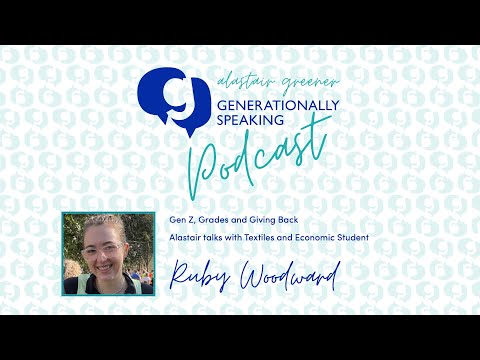
At just 17, Ruby juggles A-Levels, fashion-design ambitions and a record-breaking hospice-fundraiser. She credits her school’s “competitive compassion” culture for normalising charity work. Ruby shares how she builds peer support networks, manages exam stress through friend “debrief dinners”, and why asking older generations about their own passions is her favourite icebreaker.
Ruby Woodward Takeaways:
- Small invitations fight Gen Z isolation better than big campaigns
- Social rituals beat pricey wellbeing apps for stress relief
- Curiosity bridges the age gap, ask elders what they’re proud of
- Optimism is a performance enhancer, Ruby frames every new challenge as “exciting firsts.”
Ruby Woodward Links
Read the full transcript
Automatically transcribed, so there may be the odd slip.
Alastair Greener. Hello, and welcome to another episode of the Alastair Greener Generationally Speaking podcast, where we look at bridging the generation gap by debunking myths, tackling stereotypes, and showing practical tips on how we can build stronger intergenerational connections. Now my guest today is a sixth form student studying textiles and economics, hoping to go to university in London next year to specialize in fashion pattern cutting. She has always been interested in volunteering and fundraising for her local charities, and in fact, that's where we met the first time. So Ruby Woodward, welcome to the podcast. as my listeners and viewers are gonna find out, you don't fit that typical Gen Z Would you agree with that?
Ruby WoodwardA little bit, um, I mean. I fit a lot of it, I'd say, but then, yeah, like to do a lot of charity work, things like that. So,
Alastair GreenerAs a matter of interest in your cohort at school in the sixth form, how many others are doing charity work?
Ruby Woodwardwell for me, we're doing, or as I started in year 12, um, one of our teachers came forward in an assembly saying that there was an opportunity to be part of a young ambassadors program for Children's Hospice South Wales. And a lot of people were doing it for like their Duke of Edinburgh, um, award and things like that. But I thought it would just be a nice thing to get involved with, have some fun, make some new friends starting so form. So in my group, I think there's about 20 of us, and then we're all kind of in our own little teams, and it's done in a competitive way to see which group can raise the most money. So.
Alastair GreenerI like the fact that, um, because the one thing they do say about Gen Z is you, you've got that competitive element about you and I'm not sure whether that's your Gen X parents who were always known as the sort of quite a competitive, um, age group. And again, that's obviously a massive sweeping statement. Um, so it seems you've got quite an interesting culture in the school because I do some work in schools and I don't see this in every school I go into. Do you think talking to other people, this is unusual for your school?
Ruby WoodwardWell, because the teacher that initiated the program, he's been linked to the charity for a couple years, so I think our school's done about five years doing the ambassador's program, which I think is quite, I think it's a really good program to get involved with, but. I'd say that the school as a whole, they do try and keep people doing as much as possible, so it is definitely a school that wants you to get as much done as you can.
Alastair GreenerAnd there's no question, you know, without being patronizing, this is gonna help you massively later in life when people have prospective employers and so on. When they see that you've got this level of experience, there's no question it's gonna help you, but there must be some of your friends who are saying, yeah. Forget all that. We've got too many things. We've got social life to have, we've got other things to do. You know, do you, do you get a bit of that from other people?
Ruby WoodwardUm, I get a little bit, but then. The group that I'm doing my fundraising with, I'd say we're quite a close group anyway, so it's almost like we're socializing and we're just having a bit of fun. 'cause some of the activities and things that we've done, um, we did a half marathon, which was quite good, where we'd go out on weekly runs, um, as training. And one of my favorite things that we did was, I'm a teacher, get me out of it. So that was quite fun getting the whole school involved with that.
Alastair GreenerBrilliant. I love it. It it, it, it's so positive and, and, and, and so good. So I would say that this isn't something that's happening universally across the country. Um, it is something which is wonderfully unique to your school or certainly a rarity that your school's doing it. Outside of that, just trying to identify how much of a stereotype of Gen Z you are or aren't. What? What are your feelings about social media and how do you interact with social media?
Ruby WoodwardWell, if I'm being completely honest, I am very much stereotypical in when it comes to social media. Um,
Alastair Greenerokay. That's okay.
Ruby WoodwardI do like to get home and scroll on TikTok for a while before I get anything else done, but definitely using it in a positive way most of the time.
Alastair GreenerAnd actually here, here's a couple of things we can de debunk straight away because one of the things, this whole thing of that, that a, people are on their phones all the time. You said you do an hour before you get on with anything else. Is this something that you have as a bit of a house rule from parents that they instilled that or is this, is this self instilling.
Ruby WoodwardWell, my parents have always kind of said like, as long as I'm getting enough of my schoolwork done, all my homework, bit of revision, then it's. Kind of up to me with how much I use social media and how long I'm spending doing other things, as long as I'm getting everything I need to get done. So I think they've been quite good in the way that they've instilled that into me from quite an early age. So it is like, it's always been dependent on me wanting to do schoolwork. So it's not, oh, like I'm finally old enough to come home and I don't have to listen to what they're doing because it is kind of been put. Into my hands from quite an early age.
Alastair GreenerI was gonna say, what age did you get your first phone and was it back in those days, was it a brick phone or was it, what type of phone was it? And um, how long ago?
Ruby WoodwardI got my first phone when I was 10, I think. 'cause I started walking home on my own with like me and my sister. And it was my mom's old iPhone six I think. So.
Alastair GreenerAnd again, that's quite, that's quite interesting because there's a lot of, um, students who don't walk home at that age. 'cause obviously you're still at primary school at that point. Um, so again, there seems to be a lot of trust that you have within your family a.
Ruby WoodwardYeah, definitely. Me and my family, we are very close, so being able to just be able to have their support and things like that is quite nice.
Alastair GreenerOkay, come on. Let's be honest. Where do you clash? It's, it's all sounding too good at the moment. Where, where is the, maybe not a clash, but where, where's the a? A little bit of friction may be.
Ruby WoodwardDefinitely when I get home, usually on a Friday night when I've had a busy week at school. Everyone's tired, everyone's just hungry, things like that. Usually a Friday after school is. You don't want to be in our household, but it's not that bad. As soon as I've had a nap and a snack, I'm okay.
Alastair GreenerUm, and what are the kind of things that, you know, because at the end of the day, we know that parenting and being a teenager is not the easiest stages of life to go through. So where are the points where the, there's, there's had to be a bit of give and take. Where have been the those to, if you like, flashpoints for you as a, as as a family that you've had to negotiate and, and deal with.
Ruby WoodwardUm, well, I think, I'm not really sure. We as a family just get on quite well. So it is not really ever been too much to like battle over really,
Alastair GreenerThis is sounding too good. By the way, just so everyone's watching, this isn't someone I've set up as a perfect model. Gen Z person who's got a wonderful life, wonderful family, wonderful things. This is just a pure coincidence we happen to chat and that we got, uh, talking at that event back in bath whenever, uh, that was okay. So, um. No apparent kind of, um, friction or anything between, between the family at all, but for you, where along the way have you maybe struggled as a teenager? What has maybe not been quite so easy for you?
Ruby WoodwardWell, definitely moving from the small primary school I was at to the secondary school I'm at now, which is way bigger than I would thought it would've been going in as a little year seven, I was, I began my secondary school as a very shy, quiet. Didn't wanna show up at all, didn't want to walk into the building. So that I think was one of the big struggles for me, being able to gain my confidence in a little bit on my way through secondary school, but I'd say pretty much, or not nearly there, but on my way to getting a lot more confident.
Alastair GreenerYou know what it, it's funny that you mention that 'cause we are, we are recording this at a time when it wasn't long ago that, um, kids started the new school year and one of the things that was particularly prominent in the news was the amount of kids who are. Not going to school for a variety of reasons, and for some of them it is mental health. It is about anxiety, about going to school and especially year seven. So it might be helpful for other parents and other students of that age to understand what did you do to overcome that, that st anxiety, if you like, of going to secondary school.
Ruby WoodwardWell, on my very first day, my mom gave me one good sentence of advice that I've given to a lot of other people, and they're starting new things. But she said, you are walking into this school as it being a new school for you today, but tomorrow it's not a new school for you. 'cause you went in yesterday and it's being able to, okay. This is my first time walking in, but when I walk in tomorrow, it's not new because I came in yesterday and just the hardest bit is starting. But as soon as you've kind of got your foot in a little bit, then it is actually okay.
Alastair GreenerVery wise words from your mom. I think that's great. Um, and something we can all learn by. And you're absolutely right. It's sometimes we're so fixed on the end and something far away, but actually if you just take it stage by stage, step by step, it can actually sometimes. Be a lot less, a lot less daunting. How did you cope with all of the stress and pressure of GCSEs? How did you deal with all of that? Because that is a tough time, a lot of pressure put on you by school and home and so on.
Ruby WoodwardDefinitely, um, well, my school, again, with them offering as much as they possibly can, they had a lot of revision sessions and I went to as many of them as I could. So being able to have as much support from the teachers as possible. Um, but then coming home, doing a bit of revision to the next day, but then. Uh, kind of reassuring myself that I've been revising quite a lot leading up to it. So not putting too much on that one night before and making sure that I was still meeting up with my friends, going out for dinner with my parents every now and then, making sure that I was happy. 'cause I thought that was probably one of the most important things as well, to not just be stressed about the exams, but also to be focusing on. What's to come after as well, because I made sure I had a very busy summer booked in for after them.
Alastair GreenerWell. And we'll come to that in a moment. All of these other incredible things you're doing, I, I am particularly interested in where you think you've got this incredibly balanced viewpoint of things. You, you seem really pragmatic, very levelheaded, uh. This might be a complete fakery, but you're coming across as someone absolutely like that. What do you put that down to? How? How is it that you are like this when others seem to struggle so much getting that balance right.
Ruby WoodwardWell, I think I put it down a lot to my parents 'cause they're both very hardworking, but as soon as like they're at home, it is, they're hardworking at work and then they come home and it's kind of completely different. Like we're at home, we are chill. There's no stress, no pressure to be put on us when we're at home. Little things like that that have kind of just kind of ended up as part of me, I guess.
Alastair GreenerI think if there's people listening or watching, thinking of doing an exchange visit with someone, I think you might be at the top of their list. That sounds, sounds absolutely fabulous. So, coming to the, coming to the future, is there anything that you are maybe that you are, I, I don't wanna put words in your mouth, but is there anything that is causing you a little bit of anxiety that you're not sure about, that you're, you are maybe a little bit worried about?
Ruby WoodwardWell, obviously got a levels coming up at the end of this school year, which I feel like is a bit more pressure than I felt with the GCSEs. Hopefully they'll go okay, and then got to have UCAS applications for universities handed in quite soon as well, but not really got around to doing that yet.
Alastair GreenerGood. I'm glad you're not perfect. That's, uh, but there are other things, so Yeah. The, it, it is, there's a lot going on, isn't there? I'm trying to balance that. And let's talk a little bit about your charity work. Because you know, you've, you've been raising money for the hospice. When I saw you, you were at a, we were at a, at an event that I was speaking at, but you were part of an exhibition outside where you were drawing attention to this particular hospice, and this was part of what you do for them. Give us, tell us a little bit about the hospice, what you do and, and why it's important for you.
Ruby WoodwardSo it is a local charity or hospice that's in the Southwest, and they provide care to children and families with, um, life limiting or life ending illnesses. So. Um, I've given the opportunity to go and visit the hospice as well, which I thought was really eye-opening, and I got to see where the money that we're raising is going. And I think especially if you are getting involved with charity work, being able to see where the money you are making's going is quite a big thing because it is like, I am raising money, but it's not just a number when I go and visit. I can see how that's impacting the people that it's helping. And I got to meet a couple of the families that were there as well when we went to visit and just have a chat with them, see how like what they think about the hospice and things like that. So, and then I think also it's, the charity in a way has helped me as well because I've become a lot more confident since the beginning of year 12 and I didn't assembly to the new year twelves. About a week ago to say, this is what I've done. We are now handing over to you guys for you to have your chance at raising as much as you can. Which is quite exciting. But if I think back to year seven, me, there was no way I was standing in front of a room of 250 people telling them that they should be doing charity work. 'cause I wouldn't have wanted to have been in that room anyway. So.
Alastair GreenerWell, certainly not on day one.
Ruby WoodwardYeah, definitely.
Alastair GreenerAnd, and what about, 'cause as you said, there's a lot going on in the future. You're wanting to go to university and do textile and economics there as well, and you want to, um, it sounds like a very specific role that you want to do of this, um, pattern. So tell us, tell me a little bit more about that.
Ruby WoodwardSo since I was about 13 kind of going into. I had a sewing machine that I'd not touched really, that I hadn't really learned how to use, but at school, just before COVID, they'd kind of shown us the basics of we made a bag and that was it. So they then started kind of setting online work that was designed this, or try and draw something for this, because as teachers, when you're doing a practical subject, it's very hard for someone who's at home to say. You're gonna make this because not everyone can do it. But so I then started to kind of put together little things that I could make from videos I'd seen online. Um, and then they kind of started releasing the face mask patterns. So I then got in touch with one of my mum's friends who works at a local surgery who was still open, and I started making face masks that they could sell out the front of their surgery for people who. Didn't bring one, forgotten it at home, things like that. And I was donating money from what I'd raised there to, um, cancer research as well, which I thought was a really important charity as well. Um, but then kind of moving on from that, I started to make some clothes, try and just explore with a couple different things. And then since being back at school, I did GCSE textiles and I'm now doing a level. So it's been something that kind of started off from, I wanted to have something to do during lockdown to being something that I really want to go into as a career, and I find really interesting and fun to do.
Alastair GreenerYou know what? It, it, it's so interesting when we look at the impact of, of COVID-19 and the lockdown and how different people dealt with it. And, and the fact that you were able to be so positive about it and create something out of it is, is, is remarkable. So, you know, absolutely Congratulations to you. You must get a bit frustrated when. People start labeling Gen Z in frankly, sometimes quite negative ways. How do you respond to some of the headlines that you read, and especially when you hear the term snowflake being banded around to describe your generation.
Ruby WoodwardI just think it is a little bit like. We've had to grow up going through a pandemic. We've had years where we haven't been able to see our friends and what I'd say is some of the most difficult ages as you're growing up, being able and for people to then kind of say that, oh, you, you are a bit lazy. You're tired. You don't want to do anything. You're antisocial. You're always on your phones. We, from my personal experience, I was doing FaceTime. Like Zoom lessons at school, and then having my phone at the side of my computer on FaceTime with my friends at the same time. So we were all in the same lesson, but we could talk to each other as if we were still sat in a classroom. But we kind of developed in a way where it was, I am at home, but I'm still using my phone to communicate with my friends in the same way that anyone else would've communicated with their friends at school beforehand, but. Just 'cause I've been told I have to stay at home. I've come up with a different way of being able to experience what other people had experienced. So I think I definitely find it a little bit rude sometimes when people are putting a big, a big label on us as a generation.
Alastair GreenerYeah. And I think that's, you are absolutely entitled to feel that, especially given what you are doing. And also, you know, I'm, I'm in, in my work, I'm very aware of how. Impactful things are when you are in that age between about 10 and 14, 10 and 15. That's probably the one of the most vulnerable ages in many respects. I mean, everyone was affected in different ways by COVID-19, but I think that age group in particular, um, were. It, it, it had a dramatic impact on, on them. And you're quite right that it's, it, it'll be part of your upbringing forever that will never, never go away. Looking to the future, what are your aspirations? What would you like to achieve? What right now do you see yourself doing in say, five years time once you qualify from university?
Ruby WoodwardWell, I quite like to see myself living in London. Definitely want to get out of bath. I find that. I just thinking about London or even New York, I want to be in a big, busy city, which hopefully has a lot of things I can get involved with and stuff like that. Um, 'cause I just think that bath, I've enjoyed growing up here, but I'm ready for something a bit more, a bit more exciting, a bit busier.
Alastair GreenerAnd the chances are you will return one day. But it's, you know, it's, it's like so many people from out of London or outside of big cities, the lure of, of big cities and the excitement that brings is completely understandable. And I have to say I was one of them. I, I did, did that. And, uh, so I completely get it. And it's, it's interesting that that. Doesn't change with the generations, you know, those different life stages, you know, that, that you go through. And what about your charity work? Because obviously if you leave where you live right now, that that's going to obviously stop. Would you look at, uh, getting involved in a new charity there, or, or will you just see how it goes? Or, or what, what do you think?
Ruby WoodwardWell. So far, I've told the teacher that persuaded me to do the half marathon. I've said, I'm not doing this year's one because I've got exams, but if I go off to uni, I'll come back and do the half marathon again the year after. So I'll be back doing another half marathon at some point. Um, but then I definitely want to try and stay involved with a lot of charities and try and do as much as I can to help out because. I just think that if I've got the ability to help out, then why wouldn't I? Because if I can do something, it might not take up much of my time. It might not feel, feel like a lot for me, but to have to see the impact that it can have on someone else's life, I think is if it's not mean or if it doesn't, dunno how to phrase it. If it doesn't take a lot of mind, but it can lead to a good benefit for someone else, then. Why wouldn't you?
Alastair GreenerYou mentioned earlier on that you are in a circle of friends who are, um, involved in charities. You're doing a lot of these, uh, amazing things. I'm sure there is some friends on the periphery of your social group who may be, are not. Doing as well as you. They may be struggling. They may find it tougher. First of all are, have you got friends like that? And then how do you work with them? How do you support those friends who maybe are having a tougher time?
Ruby WoodwardWell, I just try and keep as many people involved in as much as I can. I like being able to invite people to things, make sure they know of stuff that's going on and things like that. And just making sure everyone knows about what's happening and trying to include as many people as possible. 'cause I think even just having an invite to something can make people really happy or almost change their perspective on things.
Alastair GreenerSo, yeah, so, so you effectively created a, a, a support network if you like, you know, for people around you. And you must see people, you know, bath is a reasonable size city. You must see people who are less advantaged than yourself. People who, who are struggling. And you are clearly doing a lot for, for, for charities and so on, but what goes through your mind in terms of how the rest of us are looking after those people who are struggling in the modern world?
Ruby WoodwardI just think if you are doing as much as you can, then there's nothing else that anyone can ask of you. But if there is other things that you think you can do to help other people, then it's always, it might not mean a lot to you, but it can change someone else's day. It can make someone smile and for me, that's all that really matters.
Alastair GreenerYou know what, you are such an inspiration. It's great talking to you. And I, I've tried to find little sub bits of, of, uh, vulnerability, but you've, you've done an extraordinary job. Definitely. Take, take, take this up in terms of being interviewed because you'll do brilliantly well. I wanna finish off really on some advice that you might have for other people, because first of all, for older people who make these assumptions so often mistakenly about your generation. What kind of advice would you have for older people to connect with people like you and maybe people who are not maybe as open as you are to being communicated with? What kind of things can they do to make that a little bit easier and to break down those divides?
Ruby WoodwardI just think, try and get involved with, uh, what people are doing. Try and ask if they're doing anything that they're proud of or. Anything that they like really want to share with people. 'cause most people have something that they're proud of, of themselves at any point. And just being able to find that can start a conversation of then what they want to do, what they have done, things like that.
Alastair GreenerAnd what about the other way round For those, for those Gen Zs who you think, you know what, you, you could connect better with older generations. You clearly don't have a, an issue talking to older generations. Um, we've had a fantastic conversation here, but what advice would you give to others who are struggling to get older people for whatever reason?
Ruby WoodwardAgain, just ask people what they've been up to, if they have anything that they want to share or any experiences that they've had that they think they could pass on. Advice, little things like that. But yeah.
Alastair GreenerWe all know that there's trials and tribulations of every generation, you know, whatever life stage you're going through, there's always something there. So as a snapshot of someone in year 12 about to take your, your, um, A levels and then head off to university this time next year, are you taking year out by the way, or are you going hoping to go straight to uni?
Ruby WoodwardI want to go straight there. I think if I take a year out, I probably won't end up back here and in university.
Alastair GreenerI, I love, I love your pragmatism there. Okay, so imagine in, in a year's time that's, that's what you're doing and things. So an exciting state of life. What's the best part? Actually now let's, let's finish with the best start off. What's the most challenging part about being 17, nearly 18?
Ruby WoodwardI think there's just a lot of pressure from a lot of angles, a lot of pressure about grades acceptances into uni looking for jobs. Just a lot of, just, there's a lot going on driving lessons as well. They always end up somewhere in a mix, but things like that, just a lot of pressure from a lot of different people
Alastair GreenerAnd what advice do you have to people of your age who. Are finding it more difficult to deal with that pressure?
Ruby Woodwardreach out to people. I've had a lot of conversations with my friends recently with a lot of the exam pressure we're having with Mark. And just try and get involved, get out and about as well. Don't spend a lot. I find that the more time I spend at home in bed, worrying about things, stressing about things, the worse it is. If I go out for dinner with my friends and we have a nice chat and usually at Wgar Mamas, then everything always seems a lot better than it was.
Alastair GreenerWe should say other restaurant chains are available, but I'm, I'm not responsible to anyone, so that doesn't matter. But no, that, that's fascinating. And let's finish on a high, what's the best part about being your age?
Ruby WoodwardIt is exciting. There's so much that I've got to explore and experience at the moment. Like I'm planning maybe going away with some of my friends for the first time, just us on a plane, which could end. Could end badly, but. We're looking at the positives, so hopefully being able to go to another country with some of my friends on my own, which is exciting.
Alastair GreenerAnd how do your parents feel about that?
Ruby WoodwardI think they're excited. Deep down somewhere.
Alastair GreenerAbsolutely. You know what, and a lot of parents and grandparents, uncles, aunts or whatever, they, they see youngsters going through their stages of life, and I hope that most, and I'm sure they do, are excited for you and, and almost live through your life, that as you find these new, exciting things as they did when they were your age, Ruby. It's been absolutely fantastic speaking to you. You are an inspiration to not just your age, but also to all of us in terms of what can be done and how we can achieve some incredible things in our lives. I wish you every success in your A Levels. I hope you get the grades you want and you go to the university you want, and that we hear of you sometime again in the future, achieving remarkable things in the fashion industry.
Ruby WoodwardThank you. It's been lovely speaking to you too.
Alastair GreenerThanks Ruby, and thank you for watching and listening as well. We'll be back with another episode again in two weeks time. Bye for now The Alastair Greener Generationally Speaking podcast was presented by me, Alastair Greener. It was recorded at Granary Studios and produced by James Jones. Please follow us and leave us a review wherever you get your podcasts. To find out more, visit generationally speaking.co.uk.