
Podcast · Episode 24
Freddie Miller: A Gen Z Take on Rural Revival
Guest: Freddie Miller, river management professional. Host: Alastair Greener.
Audio
Video
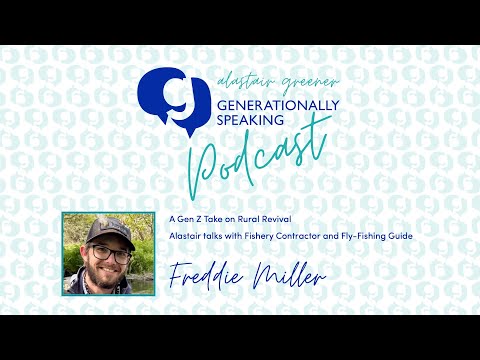
Freddie Miller shares his journey from urban London to a rural career in river management. He breaks common Gen Z stereotypes with his passion, work ethic and ability to connect across generations. A refreshing conversation about purpose, communication and the evolving relationship between younger and older workers in traditional industries.
Freddie Miller Takeaways:
- Purpose-driven work is Gen Z’s “salary multiplier.”
- Inter-generational buddying speeds up skills transfer
- Eco-certification is moving from “nice badge” to market gatekeeper
- Digital storytelling (GoPros + short-form video) is revitalising rural perspectives
- Rural careers flourish when housing and transport barriers are addressed early
Freddie Miller Links
Instagram, FreddieOnTheFly
Read the full transcript
Automatically transcribed, so there may be the odd slip.
Alastair GreenerHello and welcome to the Alastair Greener Generationally Speaking podcast, where we look at bridging the generation gap by debunking myths, tackling stereotypes, and showing practical tips on how we can build stronger intergenerational connections. Today I'm talking to, well. You can, you can definitely say that this podcast has variety, so many different people from so many different backgrounds. And today I'm talking to a fishery contractor and fishing guide with a passion for the river and countryside management. He grew up in an urban environment and has now relocated to pursue river management. So welcome Gen Z, Freddie Miller.
Freddie MillerHi there. Thank you.
Alastair GreenerGreat to see you, Freddy. And uh, we just got in, in a conversation in a pub one night and I just suddenly thought you would be a great guest to have on the podcast because one of the things that we love to do is to show different perspectives and show people from a multitude of generations and a multitude of backgrounds, and you are, without question the first person we've had who. Is involved in country pursuits in the way that you are. So very warm. Welcome, uh, to you. The first thing I wanna talk about is a little bit about your background, the fact that you started off in an urban environment and then suddenly you had the call from the country. Uh, tell us a bit about that.
Freddie MillerYeah. So, um, well both my parents were sort of grew up in, grew up in a city. Um, so I was born in London, grew up in, was there until I was, God, what, 22, 23. So left. Um, just after sort of the second lockdown, um, I think we'd all sort of got a bit fed up of, of being locked down in the city and the constraints that had, um. And also I, I started to go, went to university and did agriculture at uni. Um, which was, I think, a bit of a shock to everyone. Um, 'cause I always sort of work backwards in what I wanted to do, so I was sort of, I know what I don't want to do. I don't wanna live in a city, I don't wanna work in an office, I wanna work outside. So I sort of went backwards, went into agriculture, and here we are.
Alastair GreenerSo what was it, you know, it again that, you know, you just flipped over that, but you know, there can't be that many people who live in London who suddenly decide on agriculture. I mean, did you have any, as a youngster, did you go to farms or did you have relatives in the, in the business?
Freddie MillerUm, well, so my grandparents have a, they've got a sort of small holding sort of 60 acres, which they've never farmed since I've been alive. Um, but sort of obviously. Go and visit them on sort of weekends, holidays, and sort of grown up sort of around that environment and sort of shooting and fishing with my granddad. So, uh, so I've always sort of preferred the, the countryside to London. Um, I just, yeah, I think it, it is one of those that it all happened so quickly and it's sort of works out.
Alastair GreenerAnd it's, you know what? That happens so often, doesn't it, where people become really inspired by grandparents and I think we can never underestimate the impact that grandparents have on their grandchildren, and certainly in terms of their life choices and what they end up doing as careers.
Freddie MillerYeah, well it's, it's a, it's an odd one 'cause, uh. My granny sort of, well she was a doctor and then my granddad was career navy. So it was, they were all a bit shocked as well that I've, I went into what I went into, but um, it grew up sort of fishing with my granddad and shooting with him. So I think that's sort of where a lot of the, the passion comes from. Um, and yeah, I think as you said, I think it's people take a lot of inspiration from, from grandparents, parents, whoever it may be.
Alastair GreenerAnd one of the things that is always interesting, whenever people pick a career choice that's different from what would be considered the, the norm is, oh, well he'll grow out of it. He'll come up with something else. Did you, did you go through that kind of conversation with your family?
Freddie MillerI don't think I've went through that conversation, but I think it was definitely in the background. Um, I think I probably heard snippets of it. Um. But I think I'm, I'm one of those, if, if someone says I can't do something, I sort of quite like to prove him wrong, um, in a way. And so if they say, oh, he, he won't be a farmer. Okay. Yes, I'm not a farmer, but I'm still still working in, in sort of a, in an agricultural background in a way. Sort of, sort of doing a bit of fish farming and, and river keeping and all, all that kind of stuff. Um.
Alastair GreenerYeah. And I'm gonna give you an opportunity to do a bit of debunking of some myths surrounding your industry because again, a lot of people will have, uh, views on it, which are often founded on incorrect information. So I'll give you an opportunity to do that in a moment. But what about your friends at school, your fellow Gen Zs back in London? What do they make of all of this?
Freddie MillerUm, I think they're all a bit shocked. Um, I think they all thought that I sort of. Up sort of working in an office sort of similar to them or, or if not working in office, still living in a city, but, but doing well, I dunno, sort of professional dog walking or, or something like that. 'cause I've always enjoyed sort of being outside. Um, but I think they're all, all a bit shocked that I've ended up, ended up fishing and sort of teaching people to fish and working in that industry.
Alastair GreenerAnd, and how are your friendships now, given the fact that you've taken different career paths? You know, for some people that makes the bond stronger because you get together and, and talk about those differences. Or sometimes you just naturally drift apart because if I, I'm guessing you've got a whole new friend set, um, where you are now and where you are working. So are you still in good contact with those, uh, back in London?
Freddie MillerYeah, there's definitely sort of a, a bit of both. There's definitely a few that sort of, I've drifted away from, they've drifted away from me, but then there's some where sort of. Even though we don't see each other very often, we sort of message each other every day and sort of every now and then I'll go down to London and see them, or they'll come up here and we'll go fishing or, or shooting or something like that. So we we're always, there are a few that have sort of always sort of stayed in, stayed in contact. Um, and I, I think, well, especially from sort of boarding school kind of time, um. I've, I've always sort of been of the belief I'd much rather have five really good friends than 50 friends that I might speak to now and then, um, and those five friends from school, we sort of meet up every, sort of, every year, have a few drinks, um, parties, all of that kind of stuff, and they come fishing or I go to sort of their, their places down by the coast and have a weekend on the beach or something like that.
Alastair GreenerNow you are not, what someone would assume would probably call atypical Gen Z. That whole thing, that concept of, you know, five really good friends rather than this multiple of friends, um, that you hear about people having on, on social media. I remember when Facebook, you know, was the prominent social media platform. It was all about the amount of friends you've got. And let's be honest, most people didn't even know half the people they were friending. How is it you didn't go down that route, do you think?
Freddie MillerI am not, I think I've always been, well, I've always been a fairly closed off person in a way. Um, sort of, I'll only let off as I'll speak to loads of people, but I won't sort of. Tell them everything until I sort of can trust them in a way. Um, I think that's sort of a big thing for me is sort of that trust factor in a friendship. Um, don't get me wrong, I've still, through sort of my job, I need to have social media accounts and there are definitely people on there who I have no idea who they are. Um, but again, that's just through the, for my job really, it's sort of with, with public accounts, you need to sort of accept them to, for the algorithms and all of that. But I think that's one thing that I do sort of understand is sort of the social media algorithms and sort of how to sort of increase my, sort of my business through that, um, just with photographs and, and stuff like that. But, but no, I, I, it's. It's, it's a difficult question that, to be honest, um, yeah, I'm not a a hundred percent sure how to answer.
Alastair GreenerYou, you answered it just fine. And actually, you know what's lovely? I can tell you're in the country 'cause I can hear a chainsaw in the background. So we, we, we know that you're walking the walk. A very quick thought though about, you know, the work that you do and you hinted it there, the fact that you are. You are pursuing what would be considered a rural career? Well, it is a rural career, yet you are using all the modernities of social media and so on to run your business. Is that something that you see amongst other people that you socialize within the, in the country? Because some people from a more urban background might just think that, you know, people in the country have still got straws stuck in their hair and that they're a little bit behind the times.
Freddie MillerI definitely think there's, there's parts of that. I think that, um. You've gotta use social media as a tool. Um, it's there, use it. Um, but again, it's, it's, I think that there's, and also especially now, um, more, more, more generations using social media. Um, like it's not just an exclusive platform for one generation. You can use it as a 15-year-old or you can use it as a 90-year-old. Um, it's all the same platforms. It's just obviously different generation of different understandings of it.
Alastair GreenerAnd anybody who's watched Clarkson's Farm will know that actually there's more and more people in agriculture getting on social media and posting Instagram and TikTok videos, you know, of them pursuing their role in in the farming community. And that seems to be something that's been relatively recent. How long has it been around as far as you are concerned, social media and the work that you do?
Freddie MillerI think probably it is, it's really sort of boomed since COVID. I think a lot of people during COVID sort of. Obviously not being able to work as much sort of needed to find other sources of income and you can make money by promotions or adverts on, on your social media. So I think that a lot of, a lot of different generations started to move into that and I think that's where sort of we started to see all of sort of, sort of the influencer generation coming through. Um. And I think that it's, I'm lucky in my generation that there's a lot of people that understand it quite well. Um, so it's quite easy to, if I'm struggling with something, I can go to a friend and say, I'm not sure how to do this. Can you gimme a hand? And they know two clicks of, of a keyboard, they know what to do. Um, which, but I think especially sort of looking at the Clarkson's Farm example, I think that. A lot of sort of farming now is becoming more and more difficult to make a profit on, and I think that anything that businesses can do to make that extra revenue diversifying their business, whether that's not planting exclusive sort of, um, arable crops, but having a pumpkin patch or a glamping area on their farm. It's, it's another way of diversifying a business by using the social media.
Alastair GreenerYeah, and we're seeing, definitely seeing that more and more. So tell us exactly what it is that your, the, the way that your business runs. What do you, what do you actually do?
Freddie MillerSo I, so I've got my own business. So my own business is, I, I'm a fishery contractor. And then, so that's basically I've, I go and work at different fisheries all around the country. Um, so at the moment I'm working at. Maniford fishery, um, down near Puy. Um, sort of doing a bit of their river keeping and helping out on the fish farm and the fishery, sort of chatting with the anglers and making sure they're all all right while maintaining the site. Um, and then I also, so next week I'm working for a, for another contractor. We're going eel trapping, um, down in Froom, um, which would be good fun. Um, and then I also sort of. My, what I'm really sort of trying to get my business at the moment is more sort of guiding people, especially fly fishing, um, because that's where my passion is. I, I sort of go fishing every day, um, when I can. Um, I'd like to think I sort of know what I'm doing with it. Um, and it's, I've, I've sort of never had sort of the help growing up, um, fishing and there's not a lot of sort of people my age. Younger that are getting into fly fishing. It's sort of, I think seen a bit as an elitist sport. Um, whereas you look, 'cause it's, it's, it is, there can be expensive startup costs in it. You obviously need your rods and your reels and all of your tackle and you compare that to course fishing or carp fishing, for example, where you can pay 50 quid to get a combo set and pay five quid to go to a, to a canal and go fishing there. Whereas. Trout fishing, salmon fishing, all of that is quite sort of seen as exclusive and luxury. Um, and I think it's almost just trying to sort of break down the barriers of, yes, it can be expensive, but you can also do it for free. Um, so at the moment I'm doing a lot of sort of fly fishing in the sea, um, going for sea bass in, in, um, mullet, which is a lot of fun. Um. A lot of people sort of call mullet the bonefish of England. Um, ' cause they're incredibly hard fighting fish and difficult to catch. But you don't need to go all the way to sort of the salt flats and that in Cuba to, to go and fish from. Um, they're on our doorstep.
Alastair GreenerWhat's lovely is hearing your passion for what you do and the very different views, um, you know, throughout our communities about, you know, um, fishing about shooting and what would be considered as country pursuits. Do you see that disconnect between you and people say in more urban areas who maybe don't necessarily understand exactly what you do? Or, or, or do they get it?
Freddie MillerI think there's a bit of both. I think there's some people that are like, why are you torturing these animals? And it's like, well, it's, it's not, it's a way of living. People have done it. Since, since the beginning of time they've had to eat food and get their own food, and I, I would much rather. Go down to a lake and, and go and catch a stocked fish. It has been grown on and produced for me to go and catch rather than go into a, a wild river and go and take a wild fish out and remove the stocks of that. Um, and it's, it's the same as sort of, I'm sure, as most Gamekeepers would say, if you don't have river keepers and people working in the industry, then who's there to actually look after them and make sure that. Water companies aren't ruining them, um, as they have been in sort of recent times with sewage pumping into rivers and, and taking too much water outta them. So recently, um, I think Southern Water wanted to take a few million extra gallons of water outta the river test, which I dunno if you know, but one of the premier chalk streams in, in the world. Um, 'cause I think it's something like 75% of the world's chalk streams are in England. And that brings huge amount of tourism, um, to these areas. And if those rivers don't have anything in them, then what happens to the people that are dependent on them for their jobs?
Alastair GreenerYou are often seen as part of a generation who are more enlightened about, um, animal welfare and, you know, looking after the environment and so on. Do you find that you are sort of having to work with those who don't have that same view? Maybe they come from a more traditional view that aren't as concerned about the environment as maybe you are or, or is that just a myth?
Freddie MillerI think it's a, bit of both. I think that people that are coming and fishing and shooting have that respect for what they're doing. They're not. So, I was always brought up in a way, you're, you're not killing it just to kill it. You're killing it for a reason, whether that's for pest control or to eat. Um, and I think that if a lot more people understood that we're doing it for a reason. We're not just doing it for the fun of it. Um, yes, you get enjoyment from it sometimes, but that's not the main reason I'm doing it. I'm, I go and catch a fish because I wanna eat it for dinner, or a friend wants a fish for, for a party or something. So I go and catch it, give it to them, and they're getting the enjoyment outta it. I've got the enjoyment out of capturing it. And there's, uh, my, one of my favorite things is when I'm taking a, a young kid, sort of seven, eight years old, he's never fished before. When they first get a fish on their line, it's just that smile on their face. They know that and it's something you, you can't replicate. They're there and they're playing this fish and you know that it's only gonna last five, 10 minutes, but that might be a memory that lasts their lifetime.
Alastair GreenerPeople in your industry must be thrilled that you as a younger person coming, is coming into the industry because they need that continuity. Is it something that the industry is struggling with? Are you a bit of an outlier being so young, or actually are the more people getting involved than we might think?
Freddie MillerI think there are a few more getting involved now sort of, sort of from sort of 18 to sort of. Sort of my age, sort of 24, 25. I think there are, there is sort of a bit more of a move into it. Um, whereas I think in the past there's been a bit of a, a bit of an age gap. Um, so the majority of the people I work with are sort of mid to late sort of thirties to mid to late forties. And you look at special, especially river keepers, a lot of them now are thinking of retiring, but they don't wanna retire because they dunno who's gonna step into their shoes and they don't want to leave. Of the river with no one to, to maintain it. Um, um, and I think that obviously I, I didn't go and do fisheries at university, but I think more and more people are starting to go to sort of unis and colleges like Spaul and doing fisheries management and river keeping. Um, and I think there is more of a, I think more people are getting in into it, um, in my generation.
Alastair GreenerAnd what do you think your generation brings to the industry, um, compared with older generations in terms of your, you know, maybe your attitudes, the way that you use social media and so on. You know, what, what exactly do you think that you know, you are able to bring that is, is unique to your age?
Freddie MillerI think it's one, we wouldn't be doing it if, I think in previous generations, say sort of the 40, 50 year olds who are, are working in fisheries, they're working it because it's been a generational sort of family thing. Their father, as their grandfathers have done it and they. Being brought up, similar to farming, they're following in the family footsteps, in the family business, um, where I think a lot more young people are sort of, they're chasing. So for me, I, for me, money isn't a factora in what I do. I enjoy it. That's why I do it. I'd much rather have a great quality of life and enjoy what I do then be. Stressed and burdened with work, but be on a multimillion pound yacht every, every sort of summer in Croatia. Yes, it's nice to go on holidays, but at the same time, I enjoy what I do. So work isn't work for me. I'm, I'm sort of, it's a passion I get paid to do. Um, and I think that's a lot more younger people are, are getting involved in that because. They enjoy doing it and they, they'd rather be happy. Um, especially in sort of the age of, well, time of sort of mental health crisis and, and that, um, I think that more young people would much rather go and do a job that they enjoy and be happy, um, than go and do a job they don't enjoy, be stressed, but have obviously that financial sort of, that they're in a more financially sort of. Better off. Um, whereas for me, I'd much rather be happy in my job than be SAS of millions of pounds.
Alastair GreenerYou talked about mental health there, and, and it's a, it's a very big topic for especially the young at the moment, for a, a multitude of different reasons. And you know, I've certainly seen reports about mental health in agriculture, in rural businesses. Is it something that you are seeing and is it. Is it, uh, specific to, uh, a particular age group or is it general? What are you seeing?
Freddie MillerI, I think that it's one of those that it's, it's diff, it's, well, as you probably know, it's almost impossible to see. You can't see if someone is walking down the street if they have anxiety or depression. And it's more, I think my generation especially, look out for their mates a lot more. They, they notice when something's wrong and they're not sort of fearful to go up to a friend and say, oh mate, let's go for a pint. What's going on? Um, and have a chat about it and say, we'll go to the pub. We'll have a pin. What's going on when we leave? The pub won't talk about it. We'll talk about it in a closed environment. If you need help, gimme a call. If you don't wanna talk about it, you don't have to, but we're all here for you kind of thing. Um, and I think there is, I think there is probably, it is more, more mental health problems in young people now because of pressures and stresses, um, as well. Um, especially with sort of more technology coming into jobs and people fearing for, well, I've just gone to university, spent all this money, what am I gonna do to, to pay it off? And. Straight away from leaving university for the, for the most part, you're, you're gonna be looking at 30, 40,000 pounds of debt for before you even got a job. Um, which is, I think it just puts a lot of stress on, on young people, um, when they don't, when they're in that vulnerable position and need sort of the help to, to get through it.
Alastair GreenerYeah. And there's a lot of charities I know that help with mental health for people in rural areas who might not have access to some of the resources that are available in more urban areas. For example. Uh, you are as, as you've said, clearly in an industry and in an environment where you are around older people, uh, generally, how, how do you get on with them? How do you bridge that generation gap?
Freddie MillerI, well, I think personally I've, I've been quite lucky in how I've been brought up. I've always sort of been around sort of, um, so my, my father was literary agent. My mum was an author. So I've grown up sort of going to book launches. Where eight years old, you are the youngest by 32 years for the most part. So it is either go and stand in a corner, um, and drink your fruit juice or go and chat to someone. Um, I think that's, that's helped me in speaking to older generations and getting on with them and just conversational skills. I think that's the one thing that a lot of my generation struggle with is walking into a pub and just sitting. If you walk in into a new area pub, you've never been to sit at the bar. Wait, and if someone says something to you, just have a conversation with 'em. It's, it's, I think a, a dying sort of, don't wanna say art, but a dying skill just to go to a pub and have a conversation with someone like, like we did when we met.
Alastair GreenerExactly. I was gonna say, uh, that's exactly how we started the conversation. But of course, if that's not how you've been brought up or that's not your natural environment, you're stepping out of a, a comfort zone, what, is there any advice you could give to maybe somebody of your age who, who hasn't been brought up in that some way, who hasn't been used to that methodology of just, of getting in there and having a chat? You know, what kind of things do you think people could do to help ease that? Just the fear they have of, uh, talking to new people and, and, and bridging that gap.
Freddie MillerI think it's. You, if you look at sort of a lot of young people, they'll, they'll play a lot of video games and they'll have a headset on and they'll be chatting to people all over the world, and they won't have a problem doing it when it's behind a screen. They don't, I think it's that face-to-face conversation that a lot of young people struggle with, and I think if they just think, well, I can speak to someone on a computer who, I don't know why I, why don't I just try it? Go in, go into an a safe environment and just try it. If someone doesn't want to chat with you, you don't need to have a chat with 'em, but for the most part, there will be someone who, who will have a chat with you and just give it a go. What? There's nothing to lose from it.
Alastair GreenerAs they say in, in the movies, it's, it's the fear of fear that causes the problem, not of actually the what's gonna happen. 'cause as you say, what on earth was it gonna go wrong? You know? Um, but there is that perception that it's a, it's a scary thought. One of the things that we're all very aware of is generational bias. You know, younger people thinking maybe the older people are out of touch and that they dunno anything about technology. And then the other way around that older people think that young people are lazy, they don't wanna do stuff, and they're not motivated.
Freddie MillerOkay.
Alastair GreenerClearly you beat those stereotypes in in both fronts, but what advice would you give to older people to actually understand the younger generation better?
Freddie MillerI think it is, again, it is, even though it's a difficult one to say, talk to him and I don't have that stereotypical, or he's. Especially you look at a urban environment, a kid walking down the street in a full black track suit with his hood up. Maybe a few older people would look at him and go, oh, I don't want to go anywhere near him. He, he's trouble. He is, but he might not be. He might be just a normal kid who's, he's cold. He's wearing those clothes for, for comfort. They are comfortable clothes. Why not? I think there is a lot of just judgment straight off the bat, especially from the older generation to the younger generation. Um, but again, I think that I'm lucky in the position I am, I'm sort of always the average age of, of fishermen is older. Um, and they've, they'll come up to me and have a chat and I'll go up to them and have a chat. And I just think that it's, it takes two people to have a conversation. It can't be one side forcing on the other. Both parties have to want to do it. Um, and they, they both want, if both parties want to sort of help each other, then both parties to put in equal effort.
Alastair GreenerYeah. Very wise words indeed. And you are absolutely right. If, if, if we just put that generational bias to one side and actually treat somebody as an individual and just listen and have that conversation, it's remarkable how much you, you actually do have in common, rather than just thinking about the differences, uh, between you. I wanna finish off by asking you a question that I didn't prepare you for, but you clearly have a passion for what you do. You've been able to design your own life in the way that you wanted to, which I think is something which is a bit of a signature for Gen Z. Give me a sense of what's the best thing about being your age?
Freddie MillerOh. I think it's the opportunities we are given. Um, I think that we can go and do whatever we want to do. Um, if you're like me and you want to go and move from a city to the, to the countryside, you can go and do it. If you wanna move from the countryside to the city, there's, you can go and do it as well. I think there's a lot more help, um, for, for my generation from the older generations to get into different industries. Um, but I also think it's. It is one of those, I think it's, there's difficulties, but I think for me the, the downsides sort of a, a sort of the upsides are greater than the downsides for me. Um, yes, it's gonna be difficult sometimes and yeah, I've gotta work in shit weather, but I'd much rather do that than be unhappy. I'd much rather be cold and wet than, than be sort of sat at home doing nothing.
Alastair GreenerFreddy, I love your positivity. I love the fact that you've just stepped out of any other comfort zone and just got on with what you actually wanted to do and just dealt with it and got on with it. It's been a pleasure talking to you, uh, on this podcast. Thanks for those insights. And, uh, keep up that amazing work, uh, that you're doing and I wish you every success in your business. We'll put some details of your business in the social. So if anybody wants to come down to Wiltshire and learn some fishing, uh, we know someone they can come to.
Freddie MillerPerfect. Nice to talk to you, Alastair.
Alastair GreenerGreat. Thanks again and uh, we will be back again in two weeks. Thanks very much for watching or listening. See you soon. Bye for now. The Alastair Greener Generationally Speaking podcast was presented by me, Alastair Greener. It was recorded at Granary Studios and produced by James Jones. Please follow us and leave us a review wherever you get your podcasts. To find out more, visit generationally speaking.co.uk.